draw 3d axis on d plot
Remark: For two dimensional plots, I invite to read the tutorial how to plot a office and data in LaTeX
Creating the cartoon environment
We start our environment as a standalone document with 0.two cm border margins. To create a cartoon environment, nosotros volition demand pgfplots packet to plot our charts in a 3D axis.
When using the pgfplots package, it'due south skilful practice to allow LaTeX know which pgfplots version we are working with. Nosotros can declare the pgfplots version using \pgfplotsset{compat = <version>} command. For these plot drawings, we will work with the newest version of the pgfplots, and we tin declare it past giving newest parameter to compat option.
And then we tin can create a tikzpicture surroundings, initiate our centrality and brainstorm drawing.
\documentclass [edge = .2cm] {standalone} % Required packages \usepackage{pgfplots} \pgfplotsset{compat = newest} \begin{certificate} \begin{tikzpicture} \begin{centrality} % We volition describe our 3D plots here \terminate{axis} \cease{tikzpicture} \stop{certificate}
Turning data into plots
- Using coordinates operation
There is a command to plot our coordinates in a three dimensional axis environs, which is \addplot3 coordinates. It only needs three dimensional coordinate points equally parameter to produce a line plot.
Let'south encounter an example:
\documentclass [border = .2cm] {standalone} % Required packages \usepackage{pgfplots} \pgfplotsset{compat = newest} \brainstorm{document} \begin{tikzpicture} \begin{centrality} \addplot3 coordinates { (0,0,1) (0,0.v,0) (1,0,1) (one,1,i) }; \stop{axis} \finish{tikzpicture} \cease{certificate} Compiling this lawmaking yields:
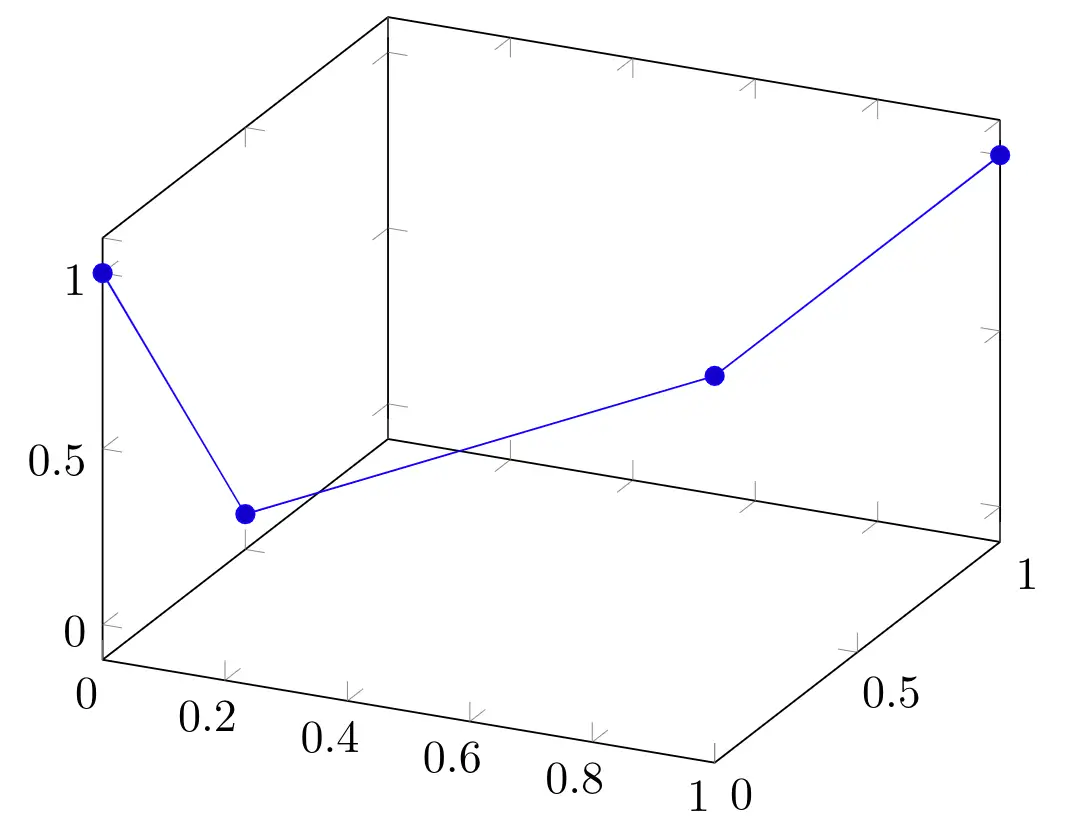
- Using table performance
This command needs a table parameter: the first line consists of the dimension names; x, y and z, and the other lines represents the coordinate points with spaces between each dimension. These lines must only contain the numbers, brackets must came in the next line afterward the table definition.
Following piece of code creates the aforementioned plot using a table control.
\documentclass [border = .2cm] {standalone} % Required packages \usepackage{pgfplots} \pgfplotsset{compat = newest} \begin{document} \begin{tikzpicture} \begin{axis} \addplot3 table { x y z 0 0 ane 0 0.5 0 1 0 i 1 1 i }; \end{axis} \end{tikzpicture} \end{document}
- Information from an external file
If we accept these coordinate information in a .dat file, we can apply \addplot3 file control to plot our information.
This command needs the relative or absolute path of our dat file in our organisation every bit its parameter. Also, our file must contain the coordinate points with a new line between each coordinate and spaces between each dimension.
Example: we created the same plot as our commencement diagram using file command. For this code to work, you must create a data.dat file with the contents below in the same directory that contains your .tex file.
\documentclass [border = .2cm] {standalone} % Required packages \usepackage{pgfplots} \pgfplotsset{compat = newest} \begin{document} \begin{tikzpicture} \begin{axis} % data.dat contains: % 0 0 1 % 0 0.v 0 % 1 0 1 % ane 1 1 \addplot3 file {information.dat}; \cease{axis} \end{tikzpicture} \end{certificate}
- 3D plot with a fixed dimension
We can besides draw line plots if the data simply contains two dimensions, past providing the third dimension as an pick to the table command.
Let's say we have a stock-still value for y dimension, and nosotros desire to apply values from a tabular array for ten and z dimensions. Nosotros tin can utilise y expr option to declare the fixed value for y dimension. Additionally, we can declare differently named columns equally a dimension, by using the dimension name with the column name as its parameter.
Example: nosotros declared the y value as 1 and added the other dimensions in the tabular array with different column names.
\documentclass [border = .2cm] {standalone} % Required packages \usepackage{pgfplots} \pgfplotsset{compat = newest} \begin{document} \begin{tikzpicture} \brainstorm{axis} \addplot3 table [y expr = ane, x = col1, z = col2] { col1 col2 -two 0 -1 0 0 0 1 1 ii 2 }; \end{centrality} \end{tikzpicture} \end{document} 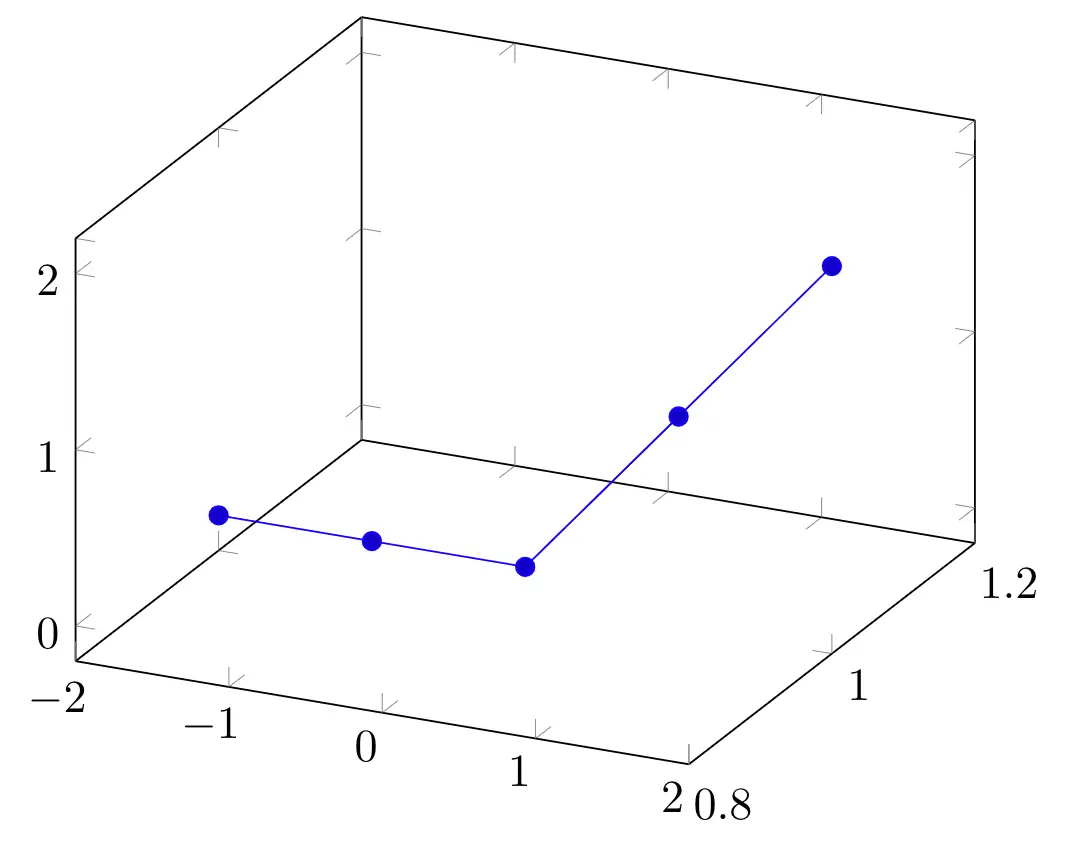
Plotting a function with ii variables
We covered the means we tin plot in a 3D environment using coordinate points. If we are trying to plot a function, nosotros can use \addplot3 command with a math expression every bit its parameter. Using this command, you tin plot a function where x=x, y=y, and z=<math expression>.
Example: Allow'southward consider plotting the function:
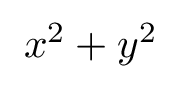
\documentclass [border = .2cm] {standalone} % Required packages \usepackage{pgfplots} \pgfplotsset{compat = newest} \begin{document} \begin{tikzpicture} \begin{axis} \addplot3 {x^2 + y^2}; \end{axis} \cease{tikzpicture} \end{document} 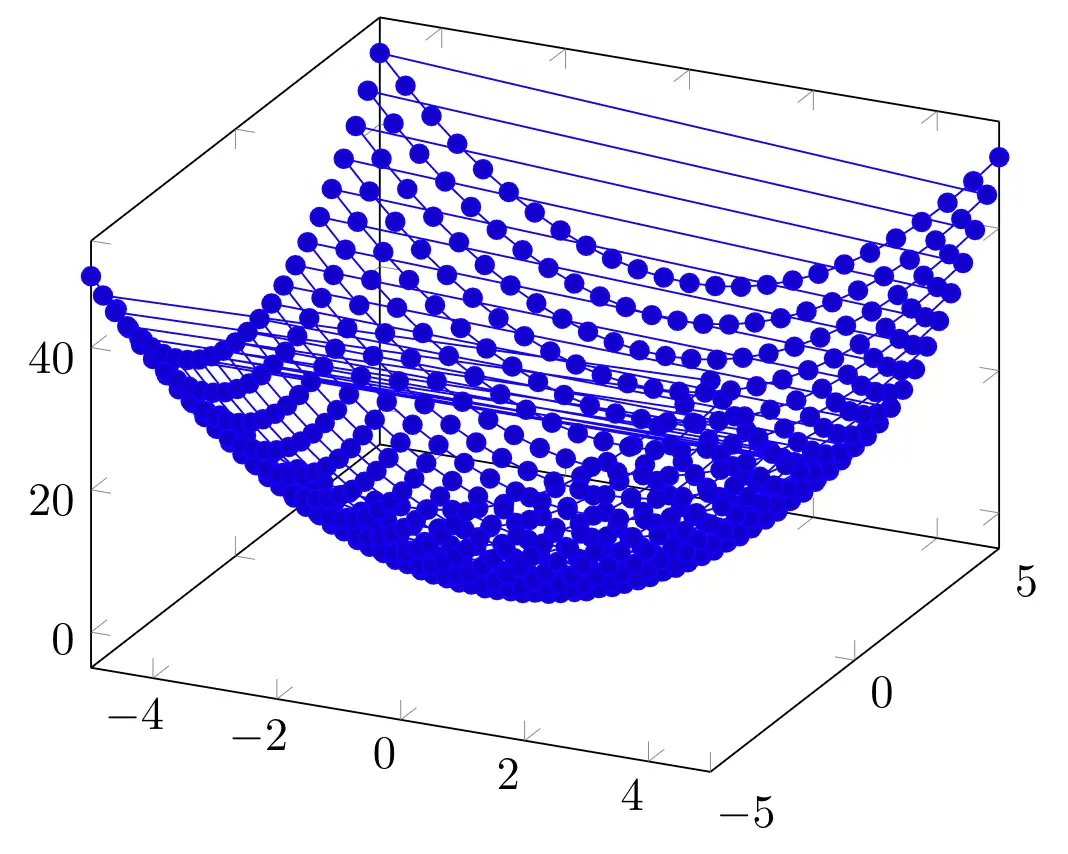
We can create the same function plot with this command using the following code:
\documentclass [border = .2cm] {standalone} % Required packages \usepackage{pgfplots} \pgfplotsset{compat = newest} \begin{certificate} \begin{tikzpicture} \begin{axis} \addplot3 (10, y, {10^ii + y^two}); \cease{axis} \end{tikzpicture} \end{document} By changing the function for each dimension, we can draw shifted versions of the office hands. Below, nosotros draw the same function but nosotros shifted x and y dimensions by 5.
\documentclass [edge = .2cm] {standalone} % Required packages \usepackage{pgfplots} \pgfplotsset{compat = newest} \begin{document} \begin{tikzpicture} \begin{centrality} \addplot3 ({ten + 5}, {y + 5}, {x^2 + y^2}); \end{axis} \end{tikzpicture} \end{document} 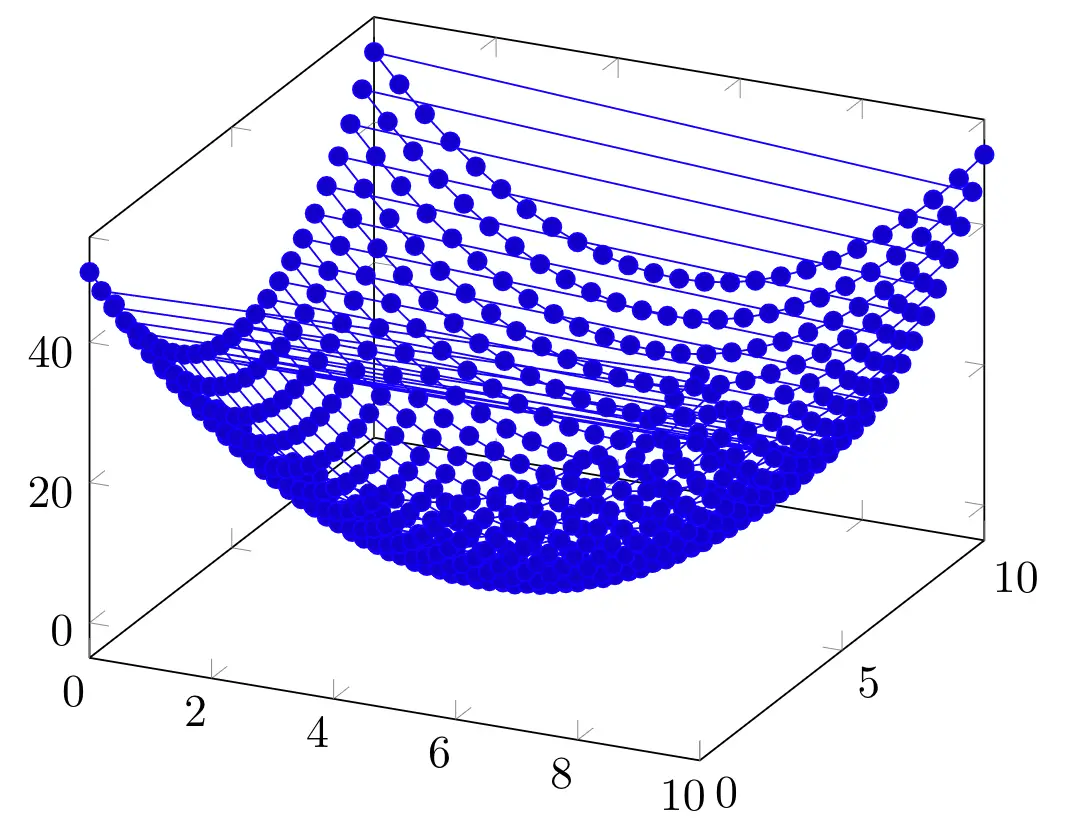
- Set variables' domains
When drawing a part, we tin set where the plotting starts and ends by declaring domain intervals.
For x dimension, we can declare the interval past calculation a domain option to our \addplot3 control. For y dimension, we need to use y domain command. If we don't declare an option for the y dimension, the domain interval of ten volition also be assumed for y. In the following piece of code, we set the domain for x at -5:2 and y at -3:ane.
\documentclass [edge = .2cm] {standalone} % Required packages \usepackage{pgfplots} \pgfplotsset{compat = newest} \begin{document} \begin{tikzpicture} \begin{axis} \addplot3+ [domain=-5:ii, domain y = -i:three] {x^2 + y^2}; \end{axis} \end{tikzpicture} \finish{document} 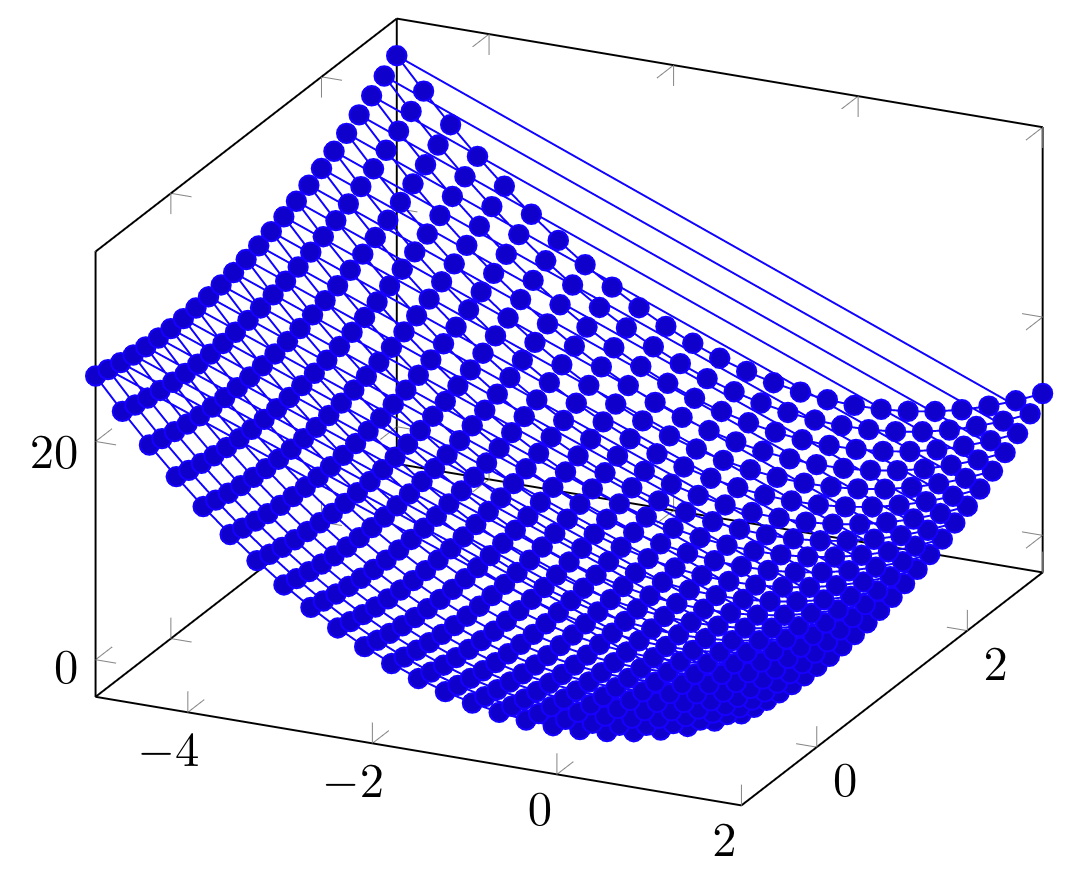
- Specify number of samples
We tin can also change the sampling size for our function. When we employ a plotting command, PGFPlots calculates the function for a sample of numbers and connects them to create a plot. We can change this number using samples choice for x dimension and samples y option for y dimension. Only similar the domain choice, if we don't declare a sample size for y dimension, it assumes the sample size of ten equally it is also for y. In the adjacent example, nosotros used 20 samples for x dimension and 8 samples for y dimension.
\documentclass [border = .2cm] {standalone} % Required packages \usepackage{pgfplots} \pgfplotsset{compat = newest} \begin{document} \begin{tikzpicture} \begin{centrality} \addplot3+ [ domain=-5:2, domain y = -iii:1, samples = 20, samples y = eight] {ten^ii + y^2}; \end{axis} \end{tikzpicture} \finish{document} 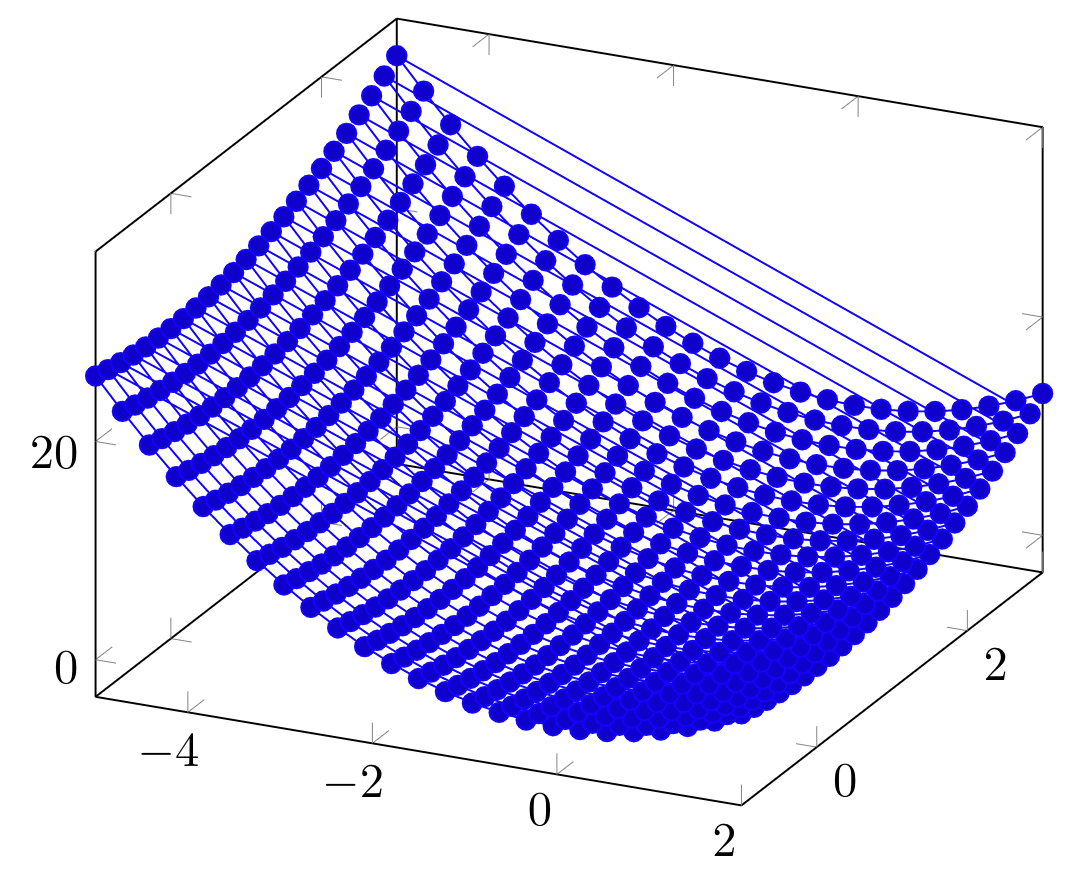
- Shine plot option
Having more samples creates a continuous wait in our plot. Since the connections between the sample points are linear, the more sample means less discrete lines and it looks smoother. Nosotros can also assistance this with shine option. It interpolates the connecting lines and creates a less clunky wait. Below, we used this choice with our plot.
\documentclass [border = .2cm] {standalone} % Required packages \usepackage{pgfplots} \pgfplotsset{compat = newest} \begin{document} \begin{tikzpicture} \begin{axis} \addplot3+ [ domain=-5:2, domain y = -3:ane, samples = xx, samples y = 8, smoothen] {10^2 + y^2}; \end{axis} \end{tikzpicture} \end{document}
Besprinkle Plots
- Merely marks
Nosotros can create scatter plots in three dimensional axis in the same way as nosotros are using in 2 dimensional axis. If we only need mark points in our plot, we can use only marks option.
\documentclass [border = .2cm] {standalone} % Required packages \usepackage{pgfplots} \pgfplotsset{compat = newest} \brainstorm{document} \brainstorm{tikzpicture} \begin{axis} \addplot3+ [ domain=-5:2, domain y = -3:1, samples = 20, samples y = 8, but marks] {10^2 + y^2}; \end{axis} \cease{tikzpicture} \stop{document} 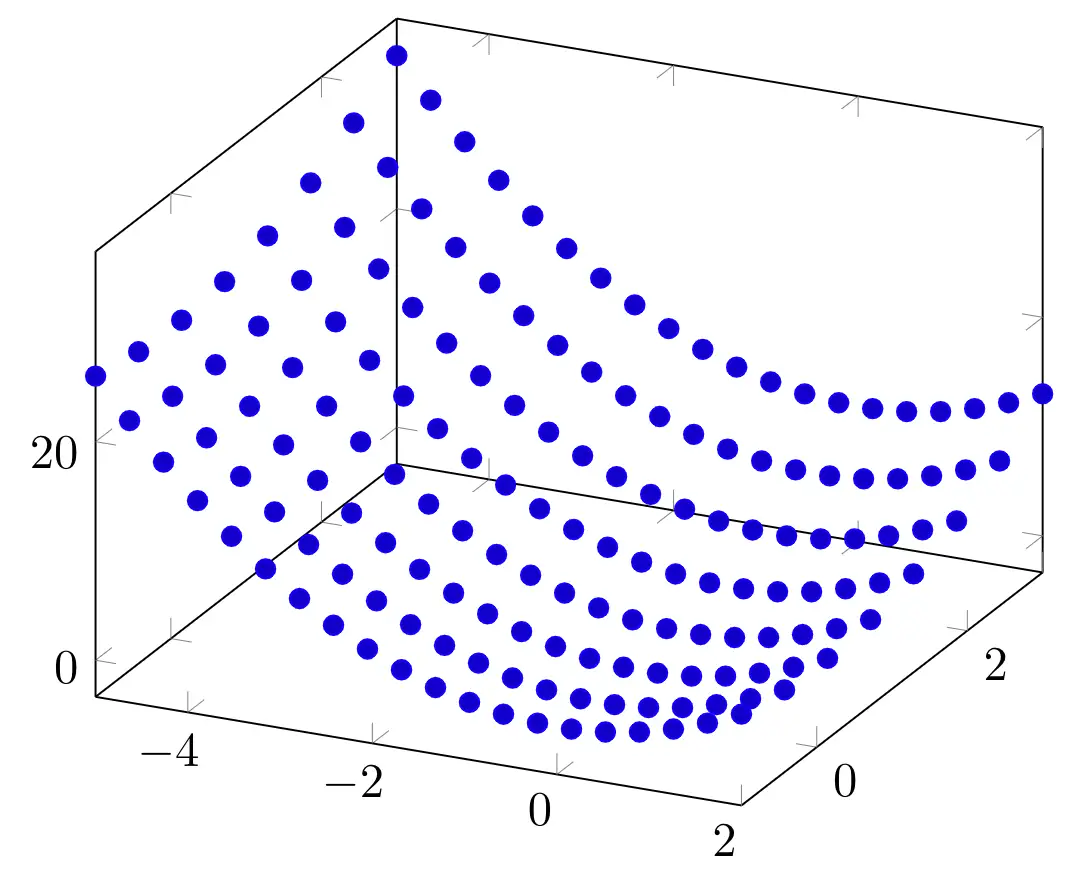
- Set color of besprinkle plot
If we besides add the scatter option, the mark points volition exist shown with the colors of the current colormap. These colors will change according to the z values of our information.
\documentclass [edge = .2cm] {standalone} % Required packages \usepackage{pgfplots} \pgfplotsset{compat = newest} \brainstorm{document} \brainstorm{tikzpicture} \begin{centrality} \addplot3 [ domain=-five:2, domain y = -three:one, samples = twenty, samples y = 8, but marks, besprinkle] {ten^2 + y^ii}; \end{centrality} \cease{tikzpicture} \stop{document} Compiling this code yields:
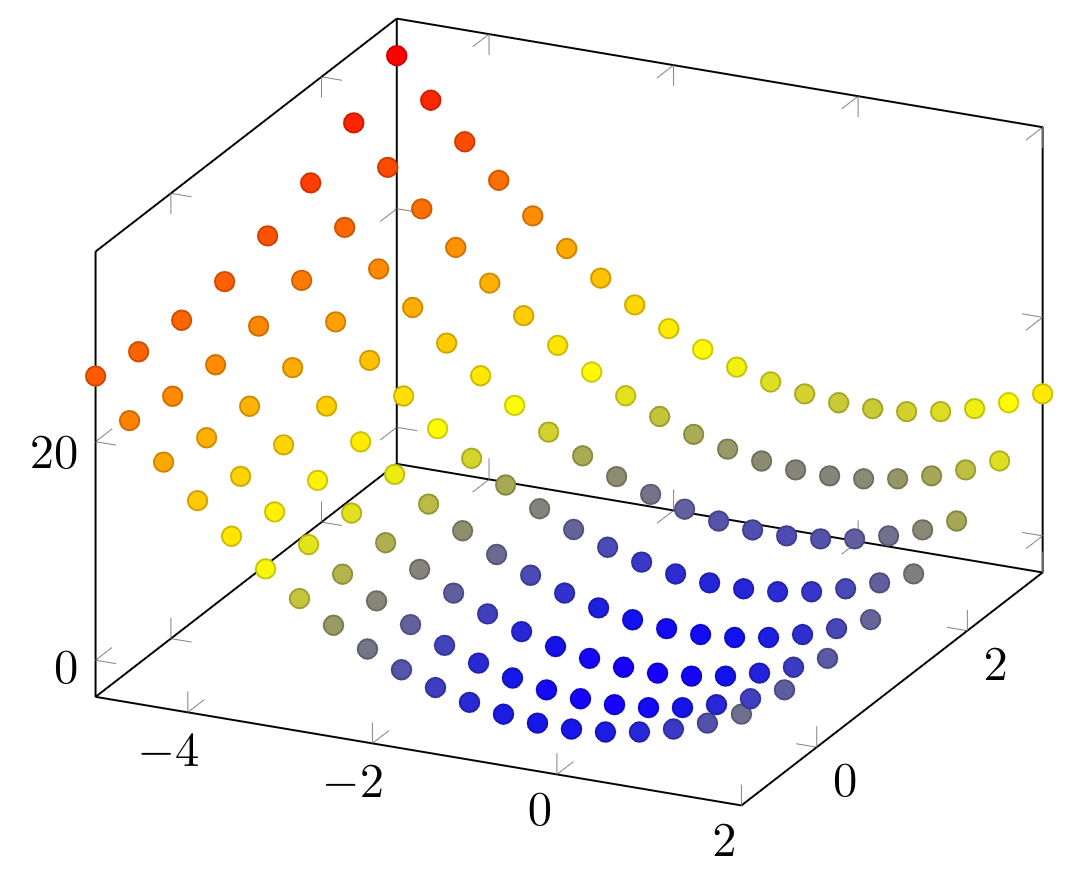
If we want to have a fixed color for all the marks, nosotros can change the color by adding the color name as an pick. In the following example, we kept the simply marks option, and used a tone of orange for the coloring.
\documentclass [edge = .2cm] {standalone} % Required packages \usepackage{pgfplots} \pgfplotsset{compat = newest} \brainstorm{document} \begin{tikzpicture} \brainstorm{axis} \addplot3 [ domain=-5:ii, domain y = -3:1, samples = 20, samples y = 8, only marks, orange] {x^2 + y^2}; \end{axis} \end{tikzpicture} \end{document} 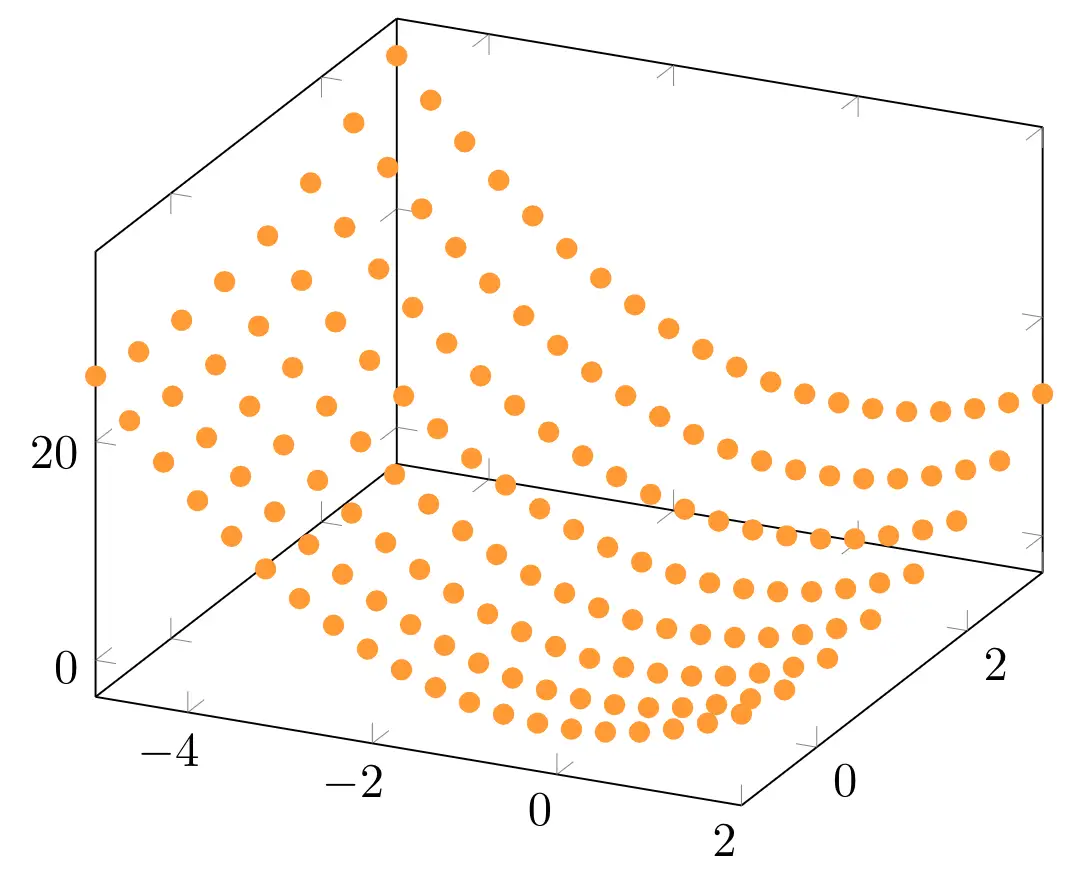
- Marks style
Additionally, we can alter the mark shapes using the mark pick. Nosotros take lots of mark shape choices with pgfplots, such equally * for filled circles, x for x symbols, + for + symbols, o for empty circles, square* for filled squares, etc.
Instance: In the post-obit lawmaking, we changed the marks with x symbols.
\documentclass [border = .2cm] {standalone} % Required packages \usepackage{pgfplots} \pgfplotsset{compat = newest} \begin{document} \begin{tikzpicture} \brainstorm{centrality} \addplot3 [ domain=-five:2, domain y = -3:1, samples = xx, samples y = 8, only marks, orange, mark = ten] {x^ii + y^2}; \terminate{axis} \cease{tikzpicture} \end{document} 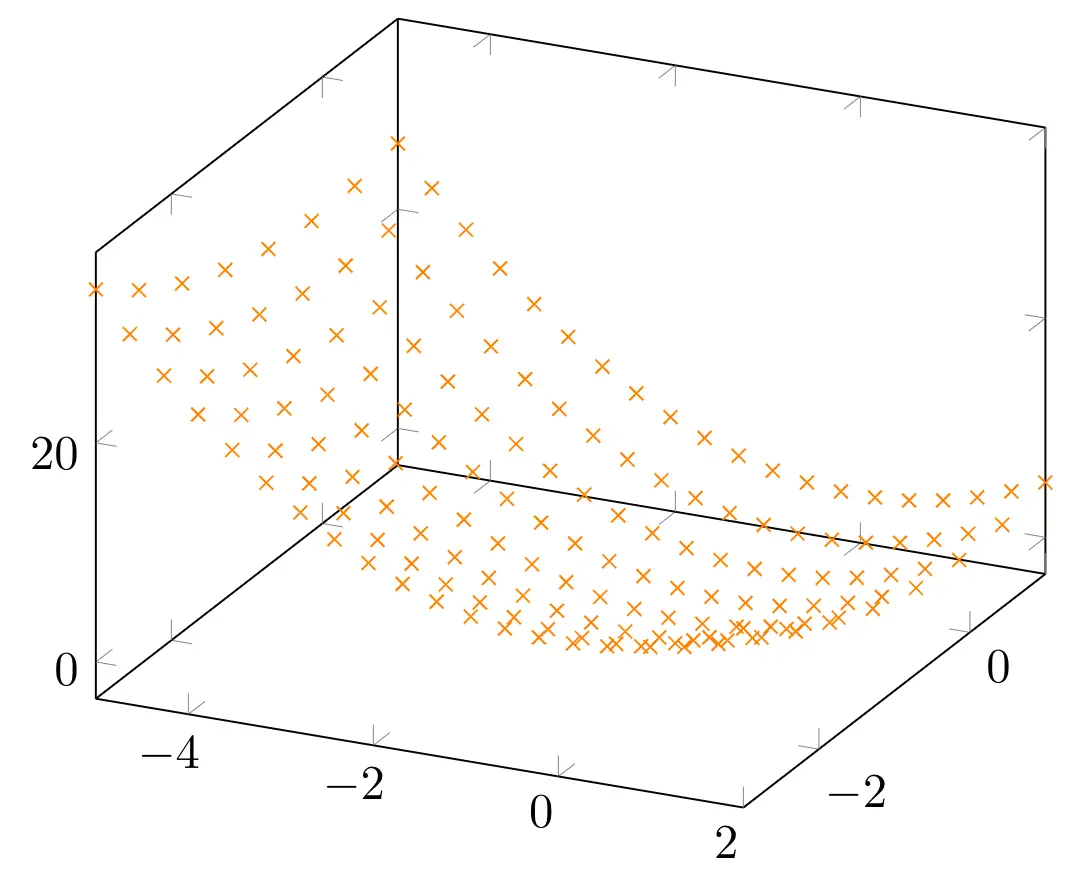
Mesh Plots
- Mesh pick
A mesh plot uses the same idea equally scatter but for creating a mesh between the sample points. It will be colored differently according to the z values of our data. Nosotros can use the option mesh to create a mesh plot.
\documentclass [edge = .2cm] {standalone} % Required packages \usepackage{pgfplots} \pgfplotsset{compat = newest} \begin{document} \begin{tikzpicture} \begin{axis} \addplot3 [ domain=-v:2, domain y = -3:1, samples = 20, samples y = 8, mesh] {x^2 + y^2}; \end{centrality} \end{tikzpicture} \end{document} Compiling this code yields:
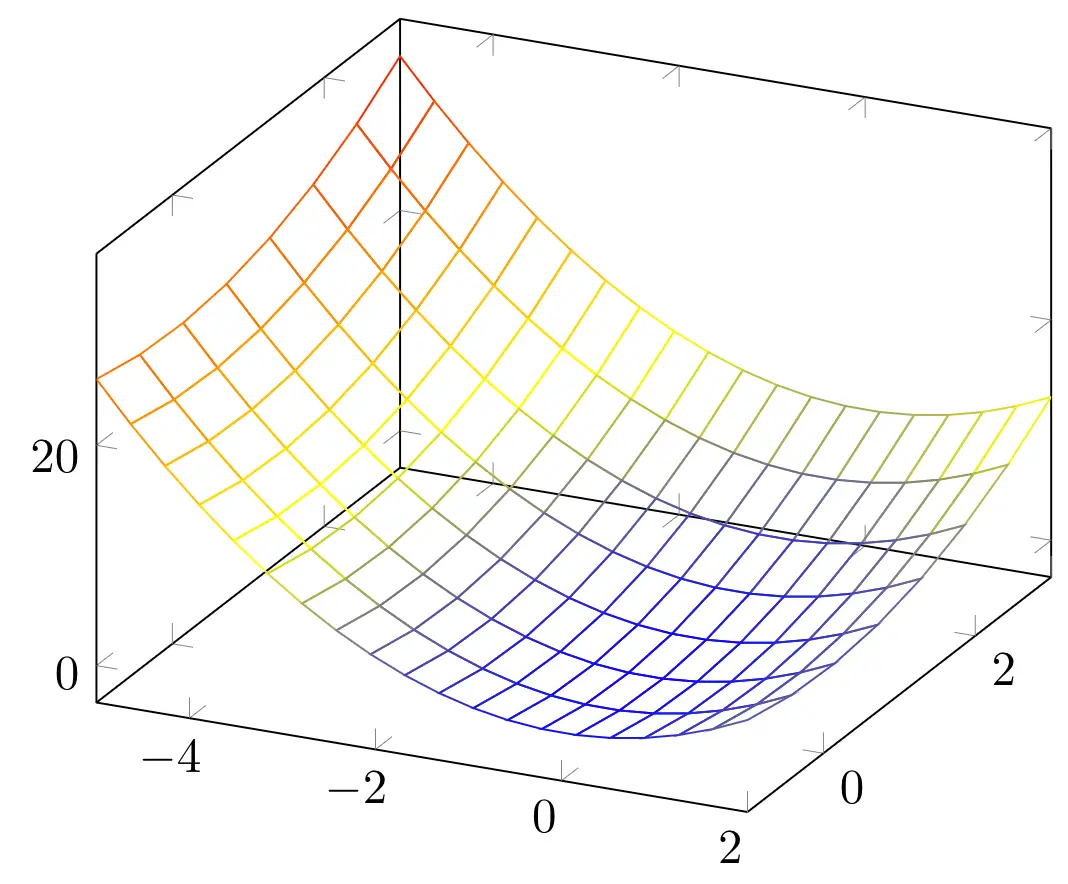
- Fix mesh color
We tin can set the color by using the draw choice with a colour parameter. In the following code, we describe a green mesh.
\documentclass [border = .2cm] {standalone} % Required packages \usepackage{pgfplots} \pgfplotsset{compat = newest} \begin{document} \brainstorm{tikzpicture} \brainstorm{centrality} \addplot3 [ domain=-five:2, domain y = -iii:1, samples = 20, samples y = viii, mesh, draw = dark-green!70!blackness] {x^two + y^ii}; \stop{centrality} \end{tikzpicture} \end{document} 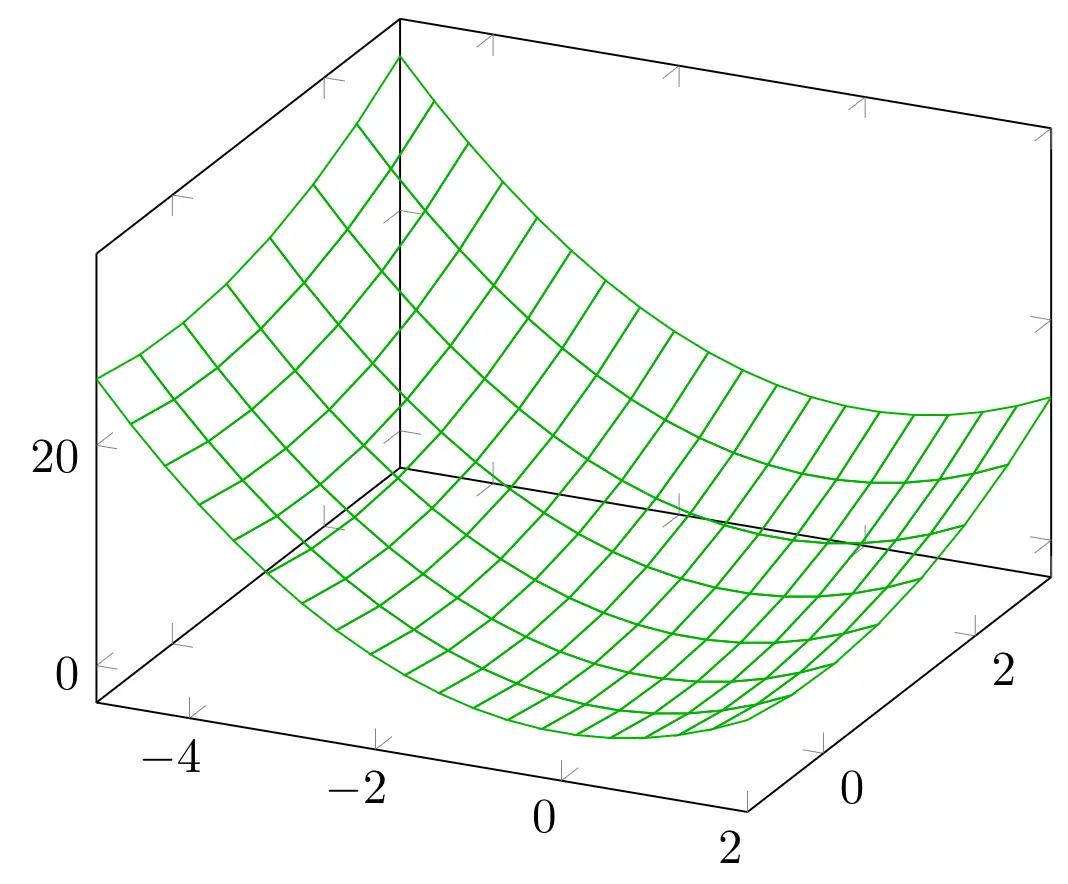
- Set line thickness
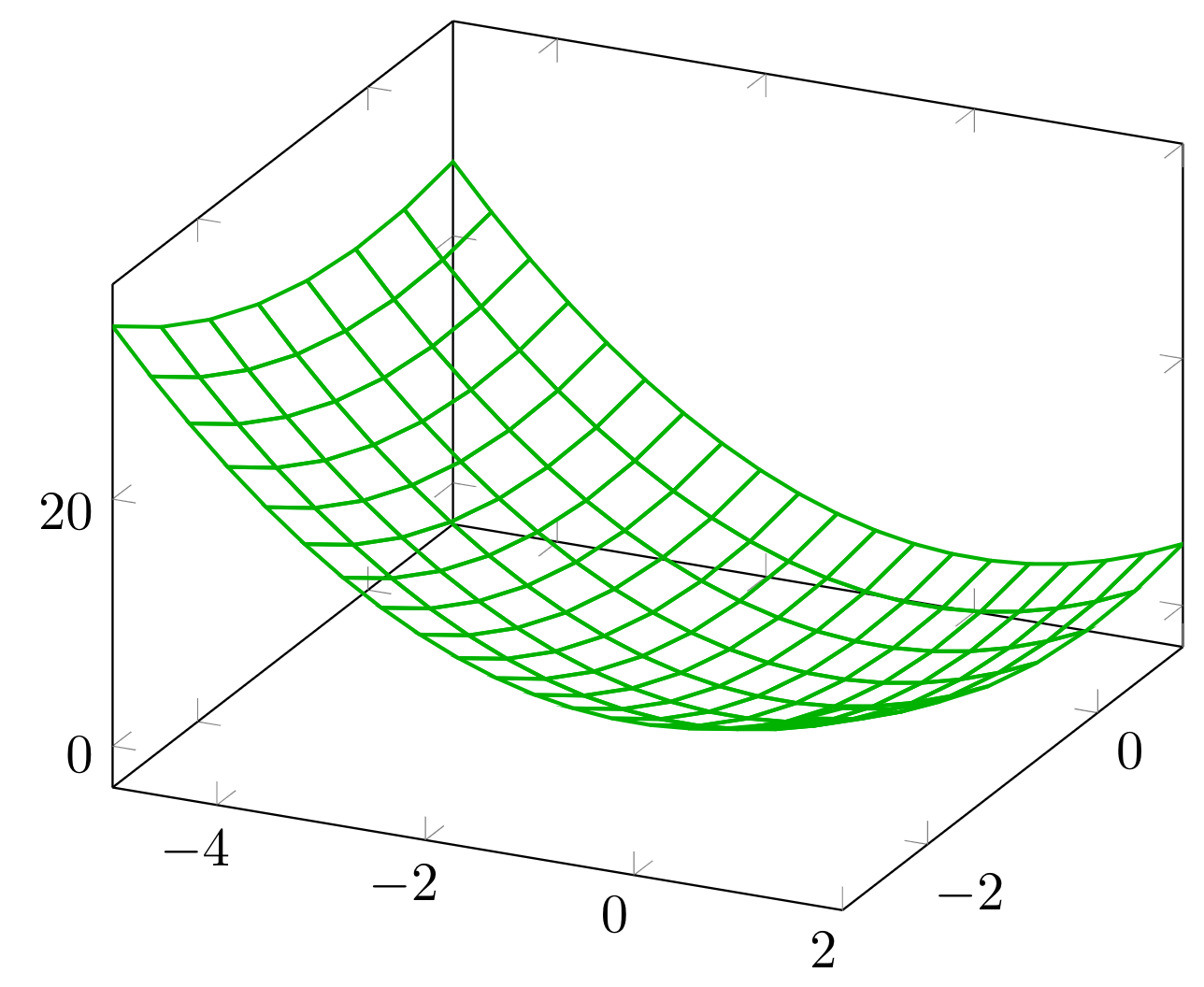
If we want to alter the width of the mesh lines, nosotros can practice that using a line width shortcut. Past default, the lines are thin . We tin can use diverse shortcuts from ultra thin , very thin , to semithick , thick , very thick and ultra thick .
If nosotros need to set up information technology to a sure level of thickness, we tin as well utilize line width option with the thickness value nosotros need. Below, we set the line width to 0.vii pt.
\documentclass [border = .2cm] {standalone} % Required packages \usepackage{pgfplots} \pgfplotsset{compat = newest} \begin{document} \begin{tikzpicture} \begin{axis} \addplot3 [ domain=-5:2, domain y = -3:1, samples = 20, samples y = viii, mesh, draw = greenish!70!blackness, line width = 0.7pt] {ten^two + y^two}; \terminate{axis} \end{tikzpicture} \terminate{certificate} which yields the following illustration:
- Mesh with scatter points
We tin can use mesh plots with scatter points hands by calculation scatter option to our usual plot. Here is an case:
\documentclass [border = .2cm] {standalone} % Required packages \usepackage{pgfplots} \pgfplotsset{compat = newest} \begin{document} \brainstorm{tikzpicture} \begin{axis} \addplot3 [ domain=-v:2, domain y = -3:1, samples = 20, samples y = 8, mesh, scatter] {ten^ii + y^two}; \end{axis} \end{tikzpicture} \end{document} 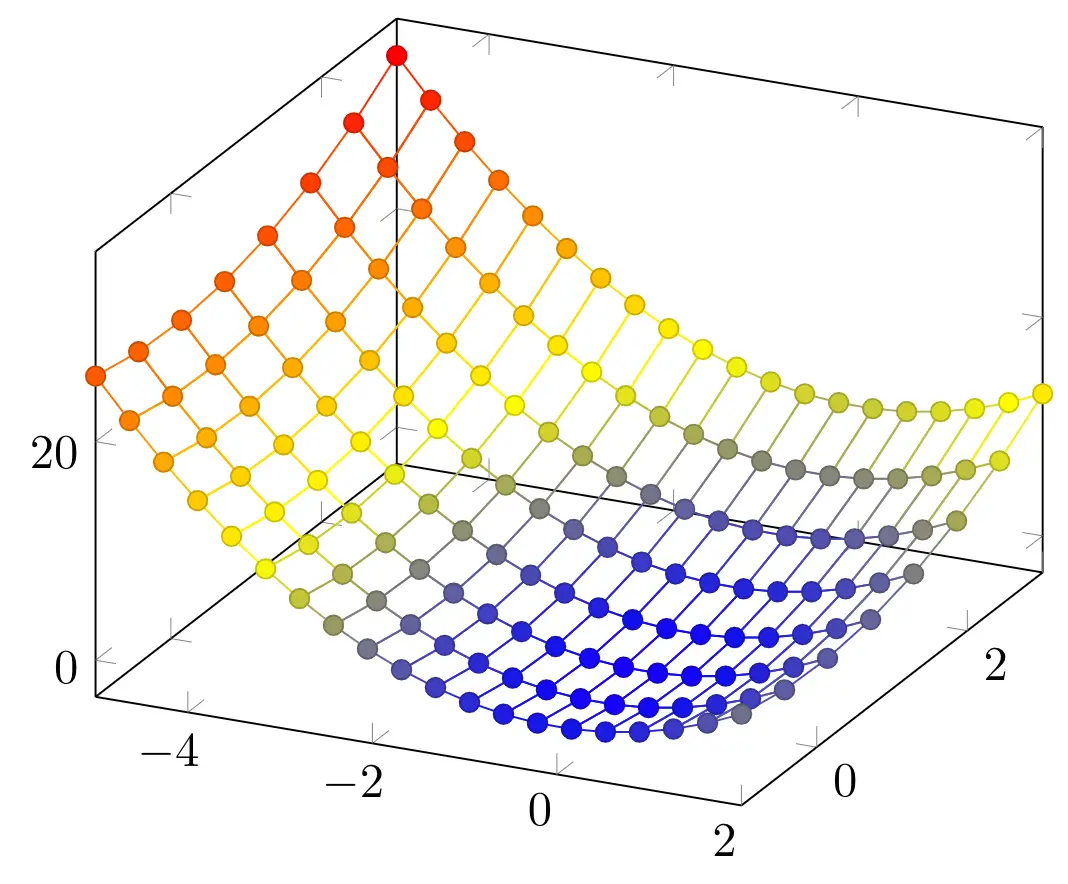
Surface Plots
A surface plot places rectangle shaped patches between the sample points and fills them using the current colormap according to their value in z dimension. We tin draw a surface plot by using surf option. In the post-obit piece of code, we created a surface plot of our diagram.
\documentclass [edge = .2cm] {standalone} % Required packages \usepackage{pgfplots} \pgfplotsset{compat = newest} \brainstorm{document} \brainstorm{tikzpicture} \begin{axis} \addplot3 [ domain=-5:two, domain y = -3:1, samples = 20, samples y = viii, surf] {ten^2 + y^2}; \end{axis} \end{tikzpicture} \cease{certificate} 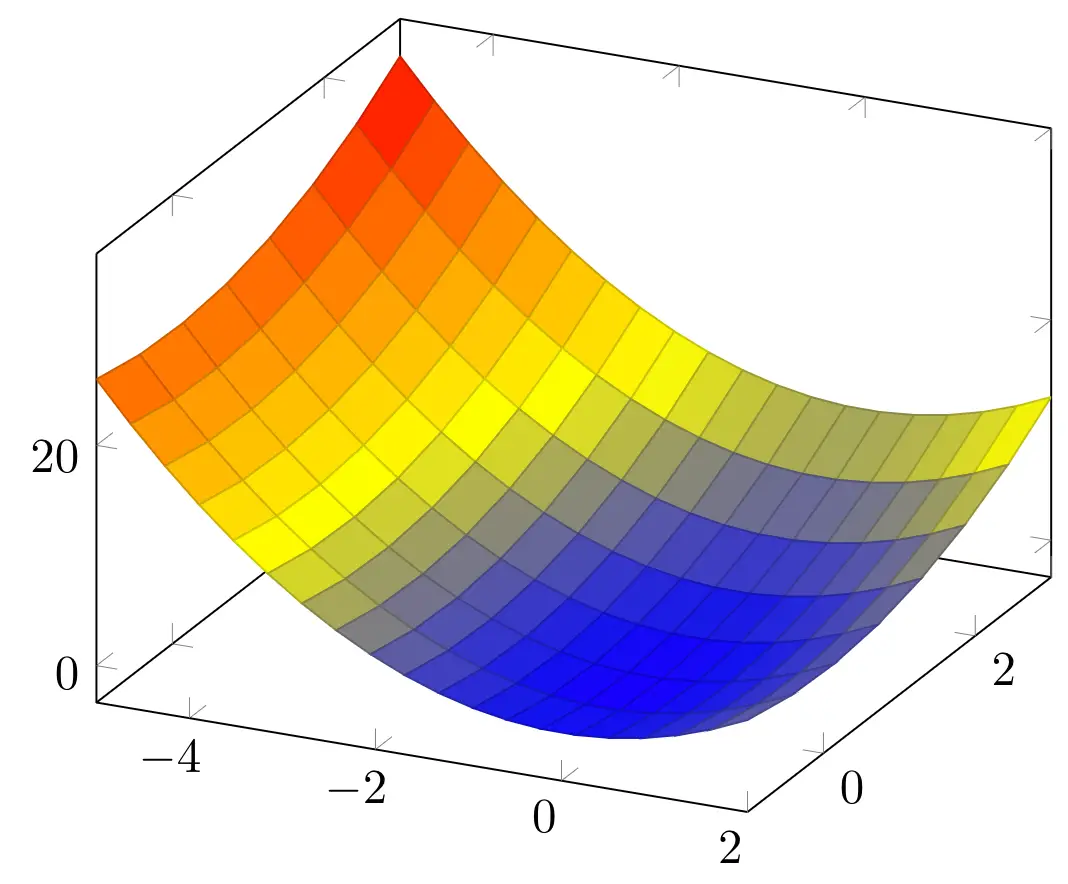
- Shader options: faceted, flat and interp
We can configure how the color of each unmarried vertex is used to fill the surface patches using shader selection. Initially, this option comes with faceted parameter, which is the version seen above. We can also use information technology with flat option: it volition utilize the filling color to depict the mesh borders. Below, we draw the same diagram with the flat choice.
\documentclass [edge = .2cm] {standalone} % Required packages \usepackage{pgfplots} \pgfplotsset{compat = newest} \begin{document} \brainstorm{tikzpicture} \brainstorm{axis} \addplot3 [ domain=-v:two, domain y = -3:1, samples = 20, samples y = 8, surf, shader = apartment] {x^ii + y^2}; \end{centrality} \end{tikzpicture} \end{document} 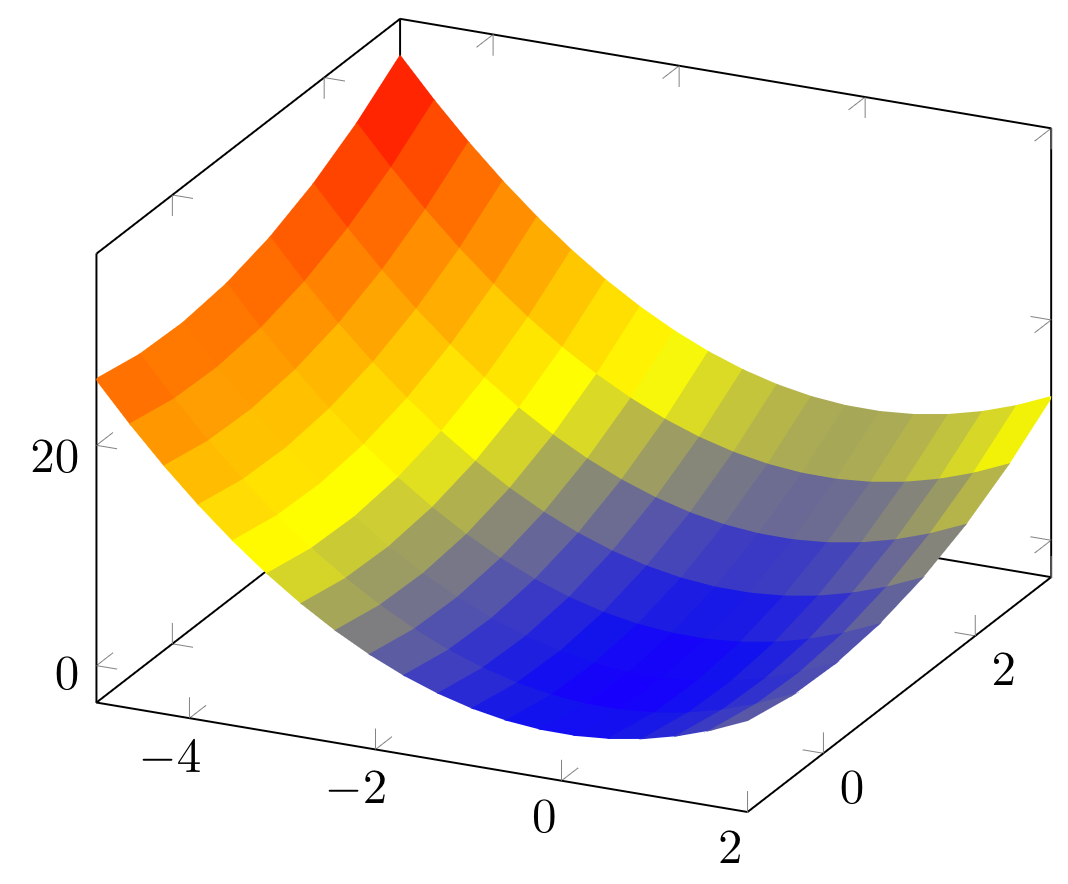
Another shader selection we have is the interp option. It uses a linear interpolation of ii triangles approximating rectangles and produces a shine filling. Below, we draw the aforementioned plot with an interp shader.
\documentclass [border = .2cm] {standalone} % Required packages \usepackage{pgfplots} \pgfplotsset{compat = newest} \brainstorm{certificate} \begin{tikzpicture} \begin{axis} \addplot3 [ domain=-five:2, domain y = -3:1, samples = 20, samples y = 8, surf, shader = interp] {10^2 + y^2}; \end{axis} \cease{tikzpicture} \terminate{document} 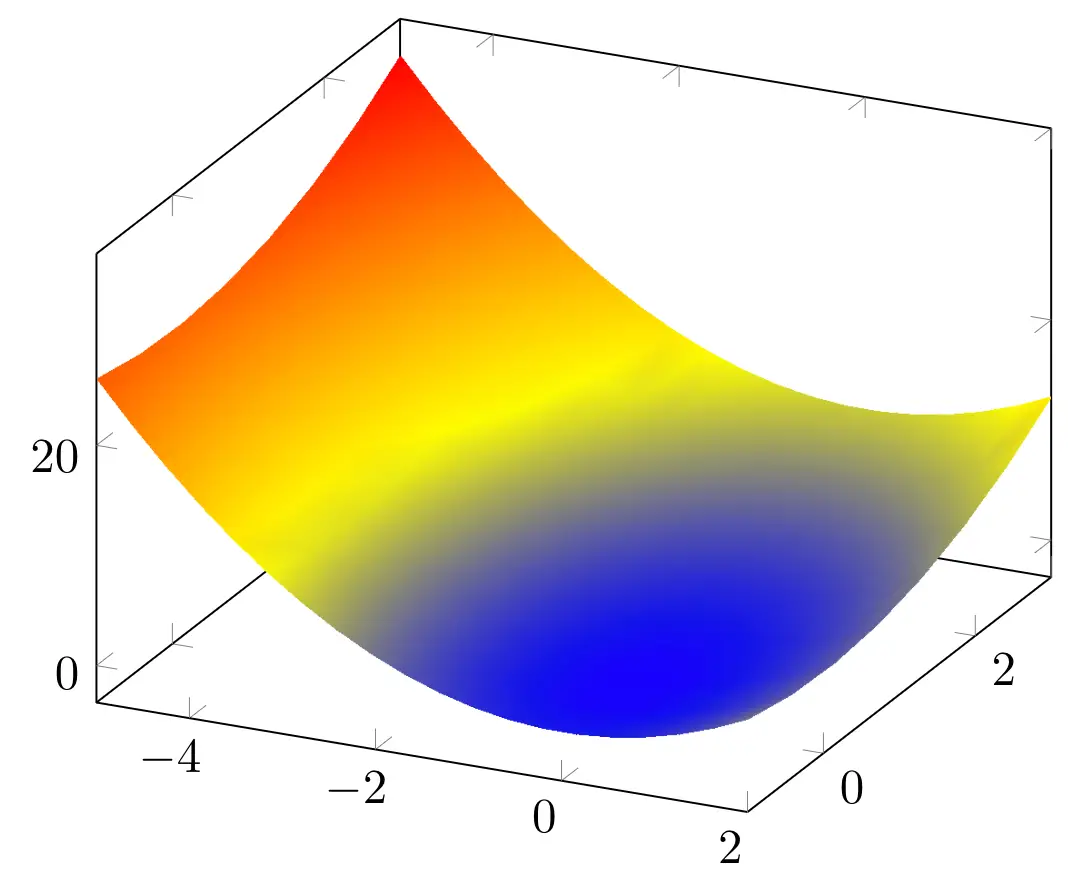
- Faceted color
When using a faceted option, nosotros tin can also change the color of the faceted lines by using faceted colour option. Below, nosotros used a faceted interp shader and teal faceted lines.
\documentclass [border = .2cm] {standalone} % Required packages \usepackage{pgfplots} \pgfplotsset{compat = newest} \begin{document} \begin{tikzpicture} \brainstorm{axis} \addplot3 [ domain=-five:two, domain y = -3:1, samples = xx, samples y = 8, surf, shader = faceted interp, faceted color = teal] {x^ii + y^ii}; \end{centrality} \end{tikzpicture} \stop{document} 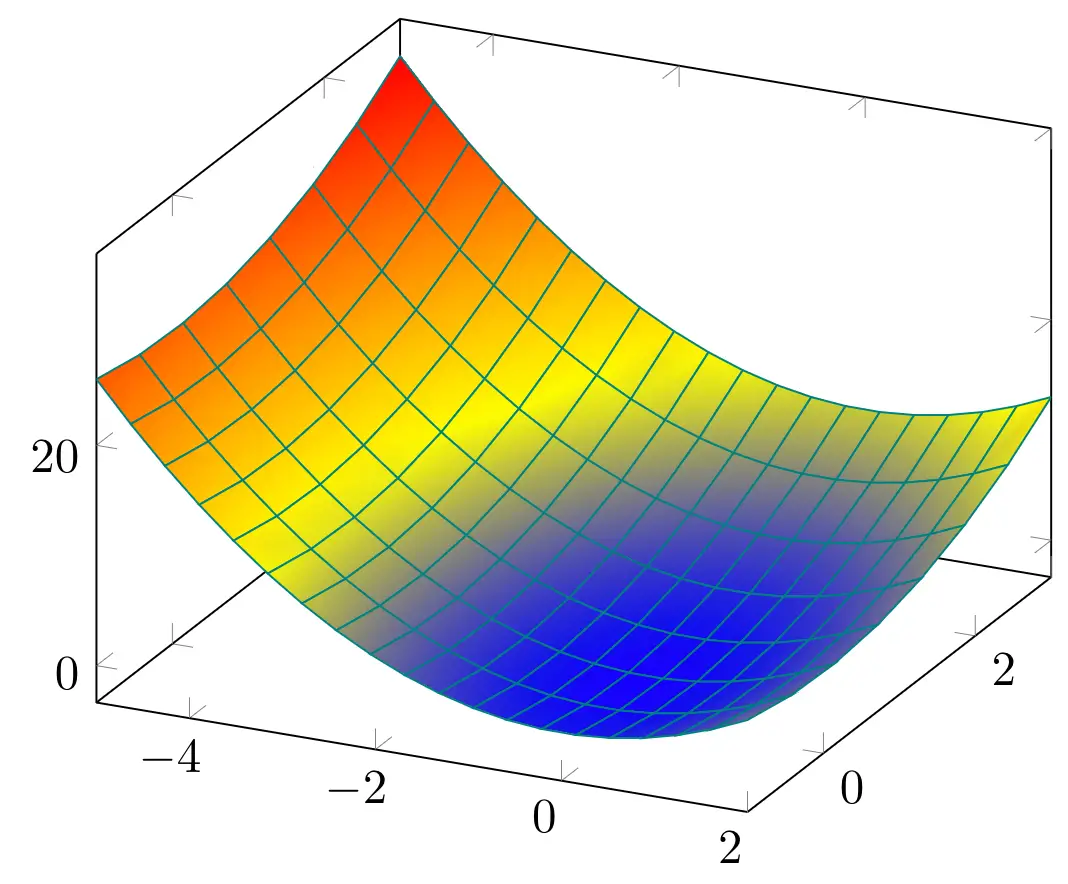
- Fill color
If we don't want to utilize a colormap, we can set the filling color of the surface plot past using fill choice with a color parameter. Below, we removed the shader options and filled the surface with pink without changing the faceted lines.
\documentclass [edge = .2cm] {standalone} % Required packages \usepackage{pgfplots} \pgfplotsset{compat = newest} \begin{document} \begin{tikzpicture} \begin{axis} \addplot3 [ domain=-5:2, domain y = -3:one, samples = twenty, samples y = 8, surf, fill=pinkish, faceted colour = teal] {x^2 + y^2}; \terminate{axis} \cease{tikzpicture} \terminate{document} 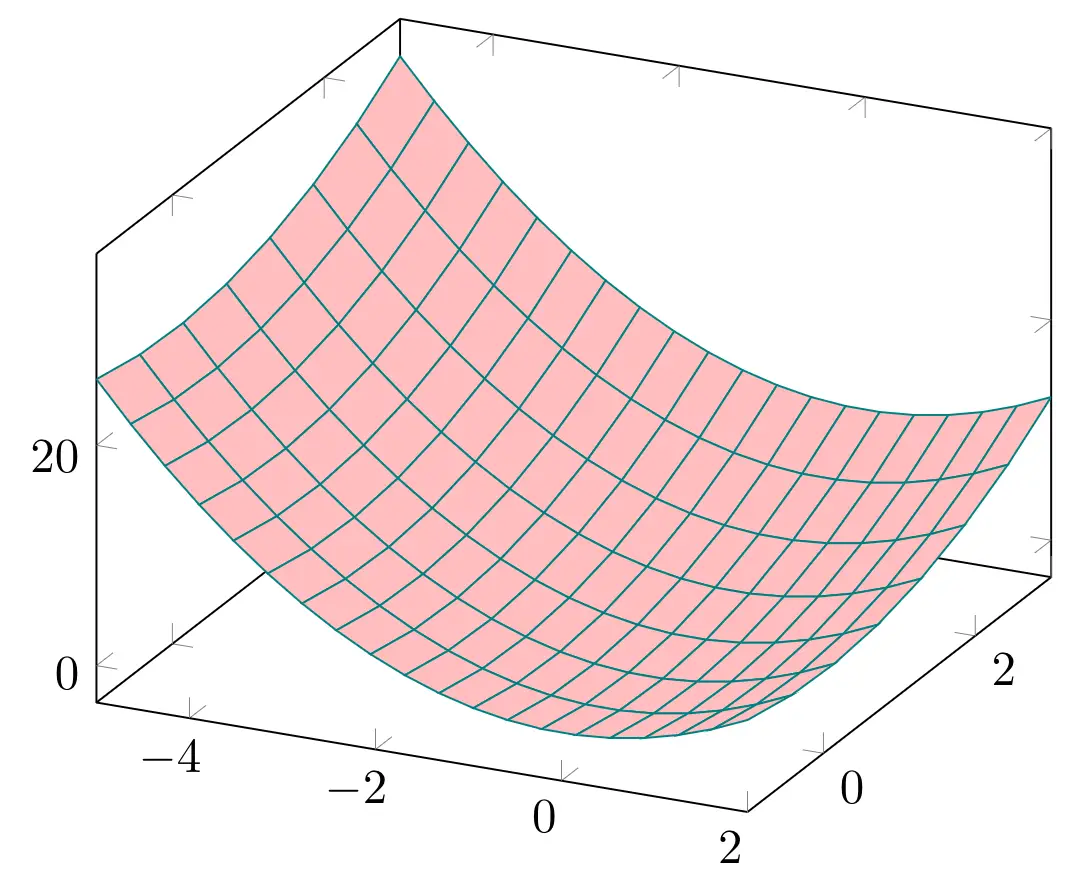
Styling 3D Plots
We went over how to create line, scatter, mesh and surface plots in a iii dimensional environment. At present let's plough our focus on how to modify the other aspects of the diagram.
- Colormap
Showtime of all, we can change the colormap of the besprinkle, mesh and surface plots. The default colormap is named hot, and can be selected by adding colormap/hot choice to the axis. The other predefined colormaps are hot2 , jet , blackwhite , bluered , cool , greenyellow , redyellow , and violet .
Example: we changed the colormap of a surface plot to cool. Hither is the respective code:
\documentclass [edge = .2cm] {standalone} % Required packages \usepackage{pgfplots} \pgfplotsset{compat = newest} \begin{document} \begin{tikzpicture} \begin{centrality}[colormap/cool] \addplot3 [ domain=-5:2, domain y = -3:1, samples = 20, samples y = 8, surf] {ten^ii + y^two}; \end{axis} \end{tikzpicture} \terminate{document} 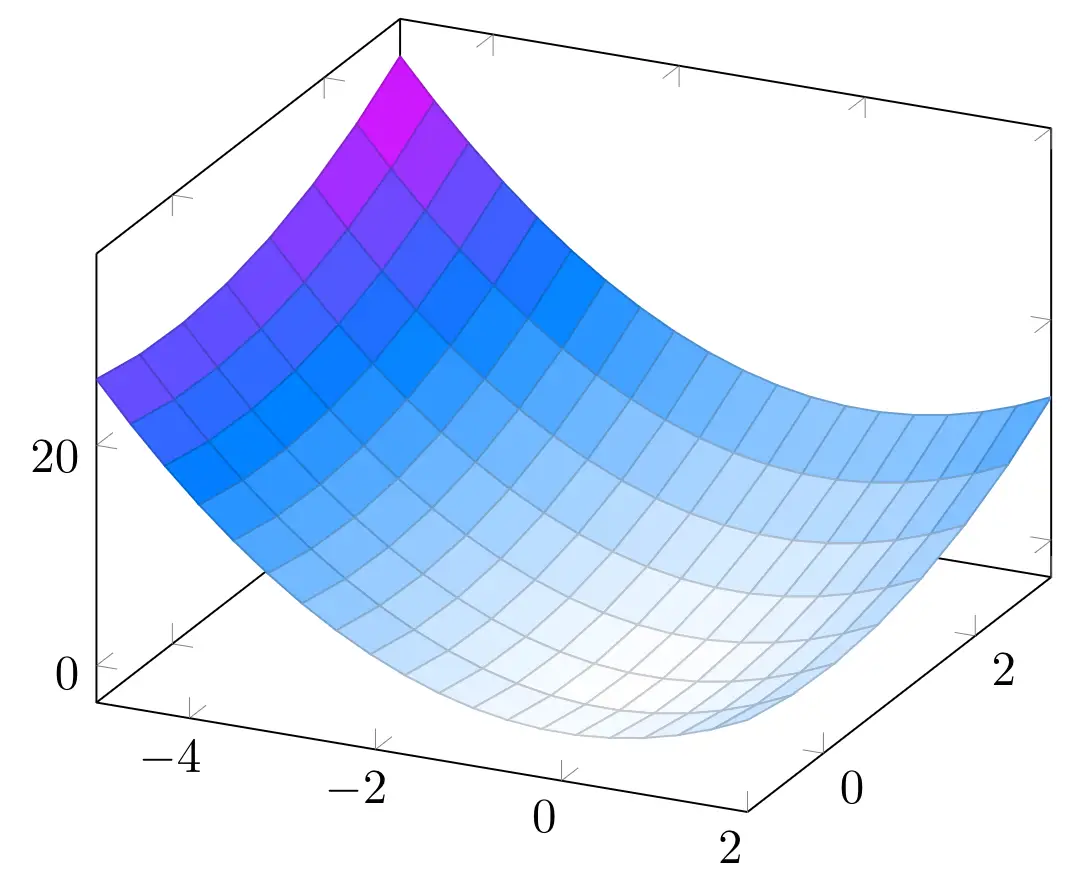
- Colorbar
Nosotros can also include a colorbar in the diagram to represent the colors according to their values. To include a colorbar, we tin can apply colorbar keyword in our axis styling options.
There are three kinds of positioning options for the colorbar: colorbar left places a vertical colorbar to the left of the diagram, colorbar right places it to the right, and colorbar horizontal places a horizontal colorbar below the diagram. In the following piece of code, we placed a horizontal colorbar for our surface plot.
\documentclass [border = .2cm] {standalone} % Required packages \usepackage{pgfplots} \pgfplotsset{compat = newest} \begin{document} \begin{tikzpicture} \begin{axis}[colormap/cool, colorbar horizontal] \addplot3 [ domain=-5:2, domain y = -iii:1, samples = xx, samples y = eight, surf] {x^2 + y^ii}; \finish{axis} \finish{tikzpicture} \terminate{document} 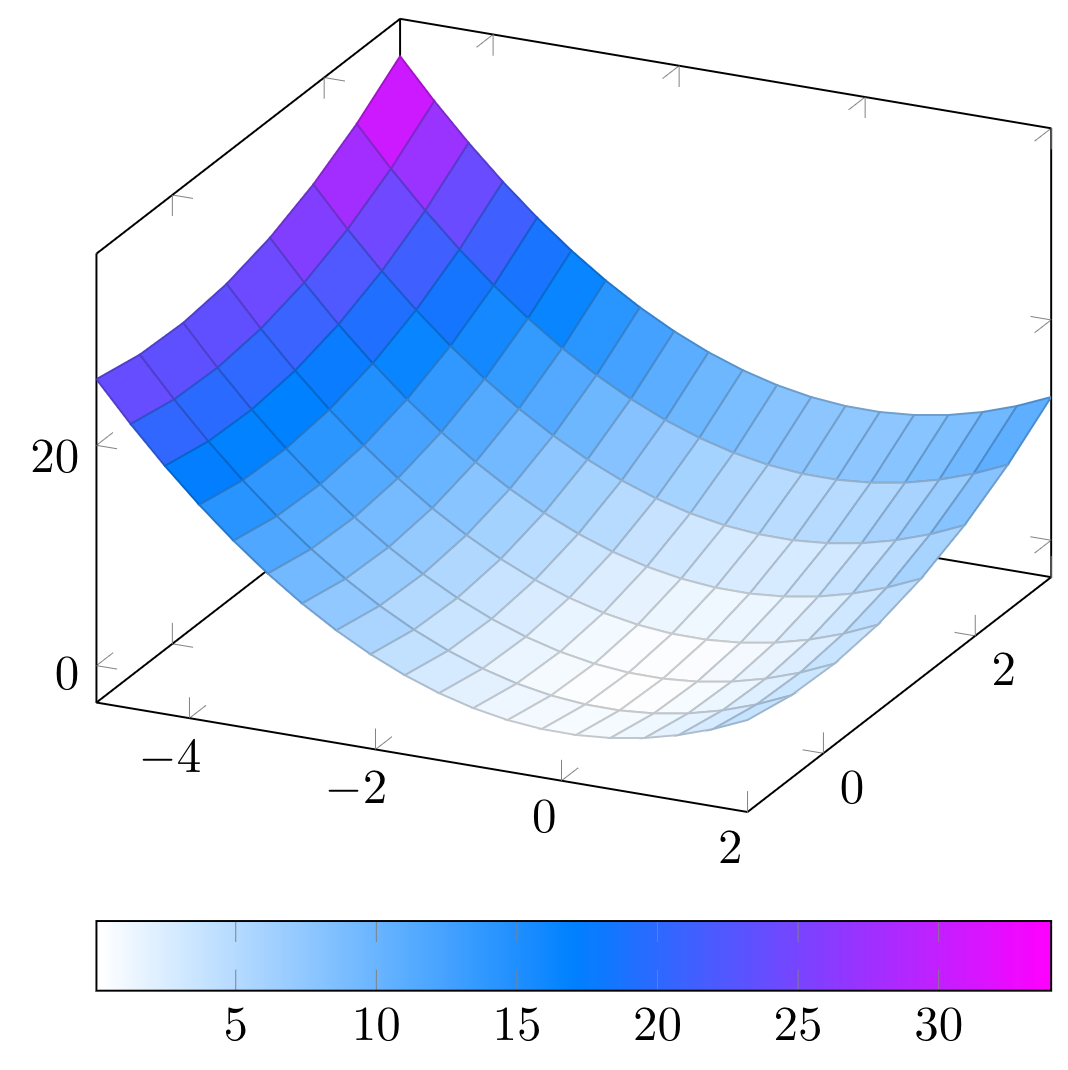
- Axis lines
3 dimensional plots are unremarkably shown inside a box axis. Notwithstanding, we tin can change this easily using centrality lines option with a positioning parameter, such as left , right , center , box , or none . Its default value is box.
In the next example nosotros returned back to the default colormap, removed the colorbar and changed the current axis positioning to left.
\documentclass [border = .2cm] {standalone} % Required packages \usepackage{pgfplots} \pgfplotsset{compat = newest} \begin{certificate} \begin{tikzpicture} \begin{axis}[axis lines = left] \addplot3 [ domain=-5:2, domain y = -iii:1, samples = 20, samples y = 8, surf] {10^2 + y^2}; \end{axis} \end{tikzpicture} \terminate{document} 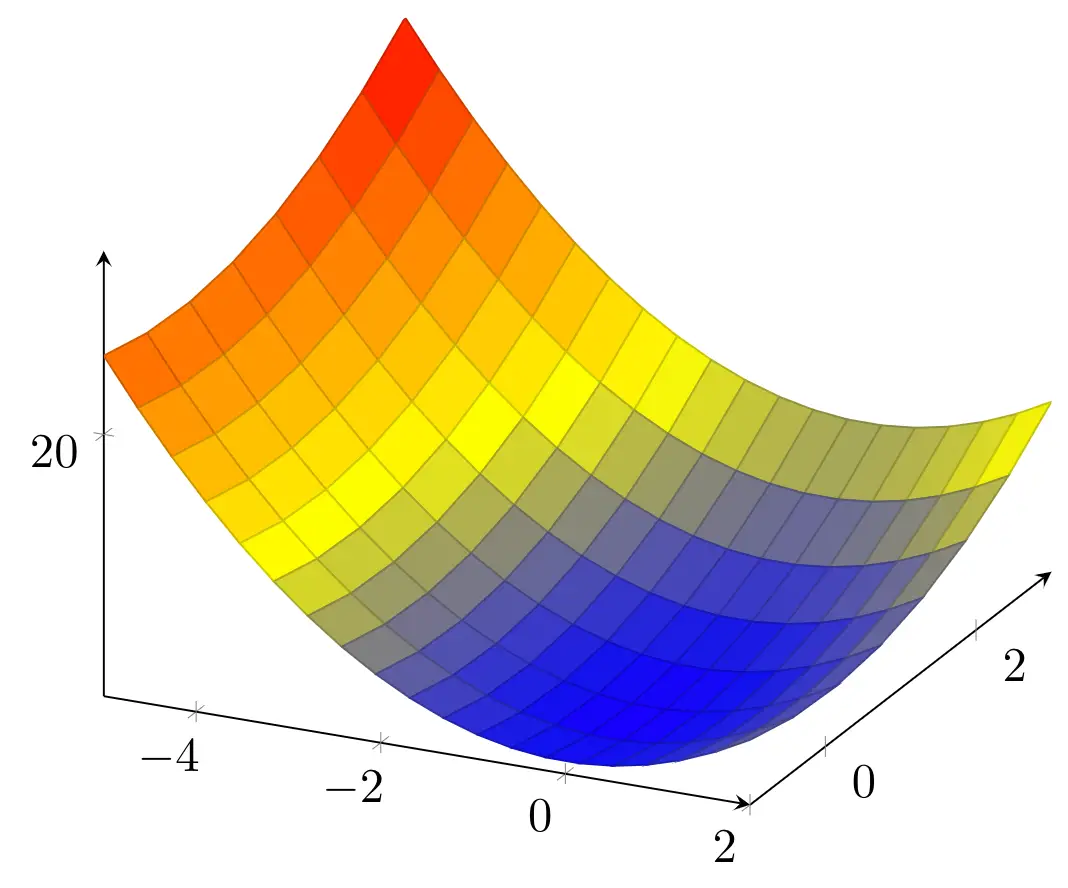
In some cases, the plot tin can stand up in front of the centrality. We can set the centrality to be always on the peak layer with axis on peak option. In the next piece of code, we set the axis lines to be at the center of the diagram, and put them on top. We also draw the lines thicker with a night carmine color by changing axis line style choice to make the lines more visible.
\documentclass [border = .2cm] {standalone} % Required packages \usepackage{pgfplots} \pgfplotsset{compat = newest} \begin{document} \begin{tikzpicture} \begin{axis}[axis lines = eye, axis on peak, axis line style = {thick, scarlet!80!blackness}] \addplot3 [ domain=-v:2, domain y = -3:ane, samples = xx, samples y = eight, surf] {10^2 + y^2}; \end{axis} \end{tikzpicture} \end{document} 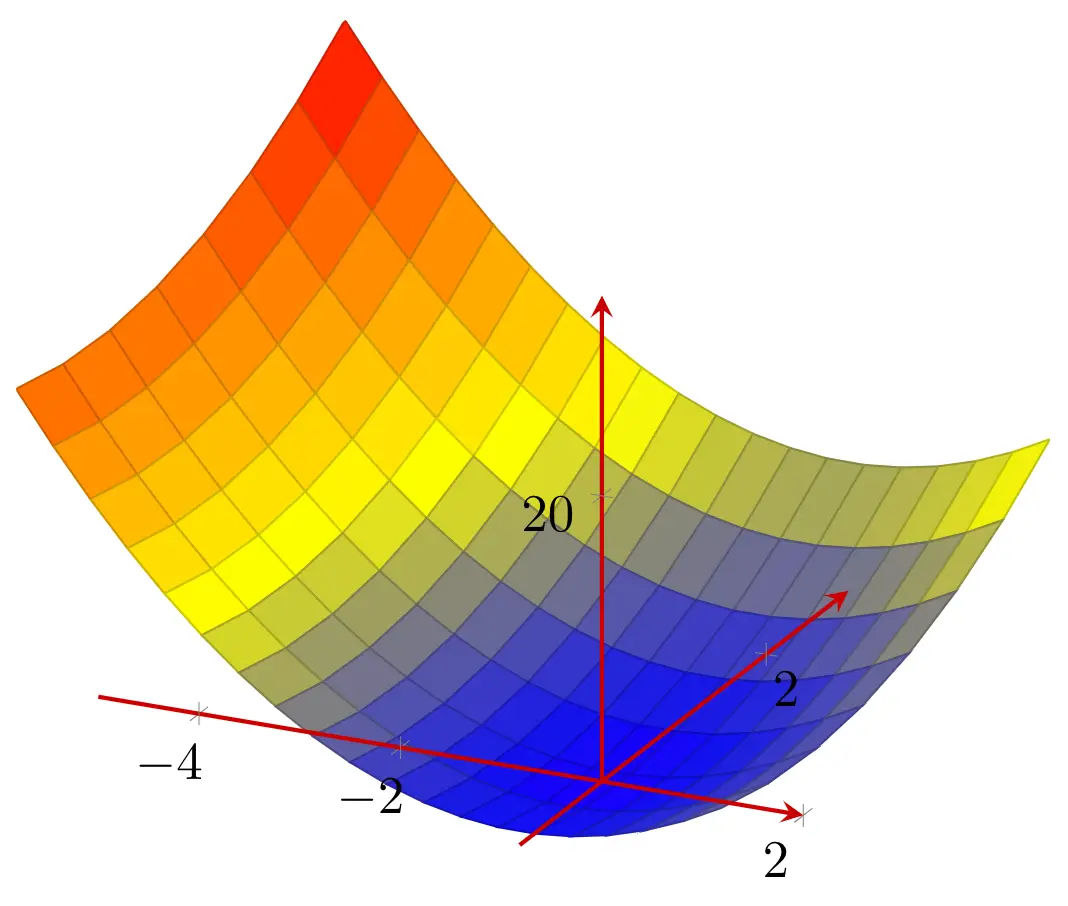
- Change plot 3D view
Since we are working with a three dimensional figure, another option we can set is the angle we are viewing the plot. We can alter the viewing angle in two directions, the first i is the horizontal angle which is rotated effectually the z axis, and the 2nd one is the vertical angle which is rotated around the x axis. We can change these angles using view option to style our axis environment. This selection has the default value of 25degrees for the horizontal angle and 30degrees for the vertical bending.
In the side by side piece of code, we set the horizontal angle to 50degrees and the vertical angle to 40degrees.
\documentclass [border = .2cm] {standalone} % Required packages \usepackage{pgfplots} \pgfplotsset{compat = newest} \brainstorm{document} \begin{tikzpicture} \begin{axis}[view = {50}{xl}] \addplot3 [ domain=-v:two, domain y = -3:1, samples = 20, samples y = eight, surf] {x^2 + y^2}; \end{centrality} \end{tikzpicture} \end{document} 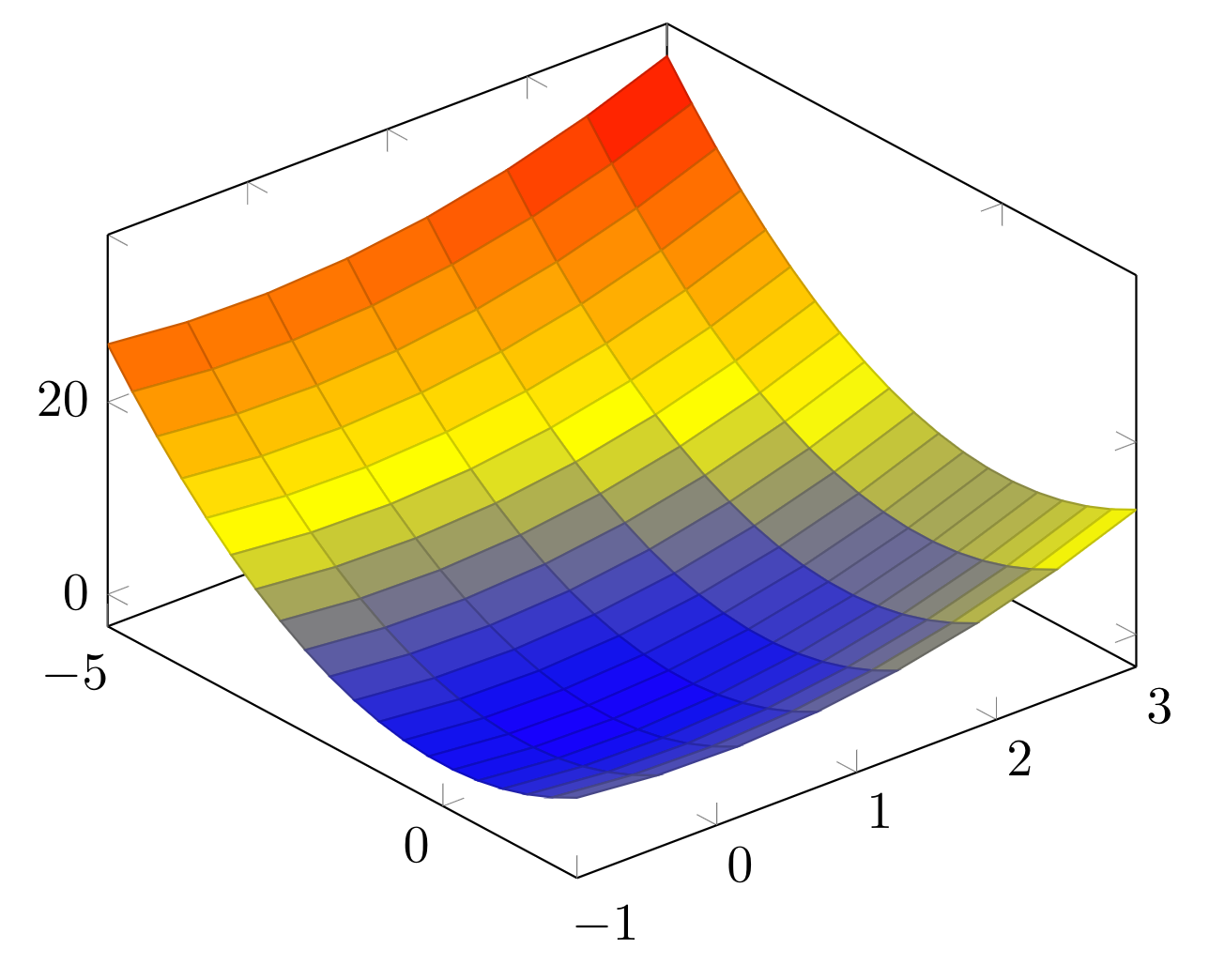
- Set axes limits
Nosotros have the option to ready the maximum and minimum values for all three dimensions. We tin declare the limits using xmax, xmin , ymax , ymin , zmax , and zmin options for our axis surroundings.
In the next example, we set the limits for 10 dimension between -6 and 4, y dimension between -3 and three and z dimension between -ten and 50.
\documentclass [border = .2cm] {standalone} % Required packages \usepackage{pgfplots} \pgfplotsset{compat = newest} \brainstorm{document} \begin{tikzpicture} \begin{axis}[view = {50}{twoscore}, xmax = four, xmin = -6, ymax = iii, ymin = -3, zmax = l, zmin = -10] \addplot3 [ domain=-5:ii, domain y = -3:1, samples = 20, samples y = 8, surf] {x^2 + y^2}; \end{axis} \end{tikzpicture} \end{certificate} 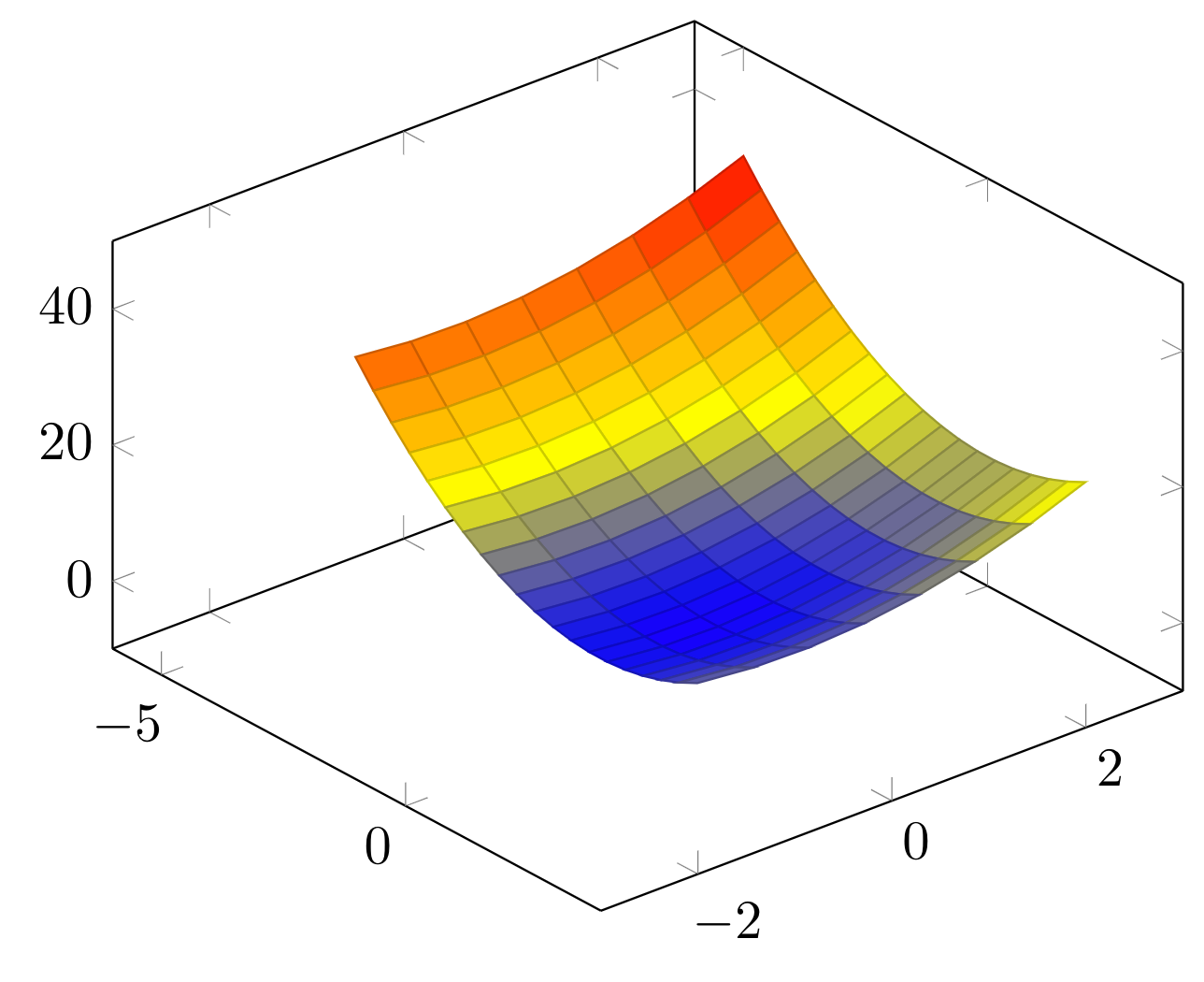
- Custom ticks labels
If we desire to emphasize sure coordinates in the axes, we can specify which tick points will be drawn by using x ticks, y ticks and z ticks options in our axis environment. These commands needs one or more coordinates in the axis, and these points need to be inside the limits we declared previously. Below, nosotros set a different prepare of tick points.
\documentclass [border = .2cm] {standalone} % Required packages \usepackage{pgfplots} \pgfplotsset{compat = newest} \begin{document} \brainstorm{tikzpicture} \begin{axis}[view = {50}{40}, xmax = four, xmin = -vi, ymax = 3, ymin = -3, zmax = 50, zmin = -10, xtick = {-6,-iv,-ii,0,2,iv}, ytick = {-3,0,three}, ztick = {-10,x,30,50}] \addplot3 [ domain=-5:2, domain y = -3:ane, samples = twenty, samples y = viii, surf] {x^ii + y^two}; \stop{axis} \end{tikzpicture} \end{certificate} 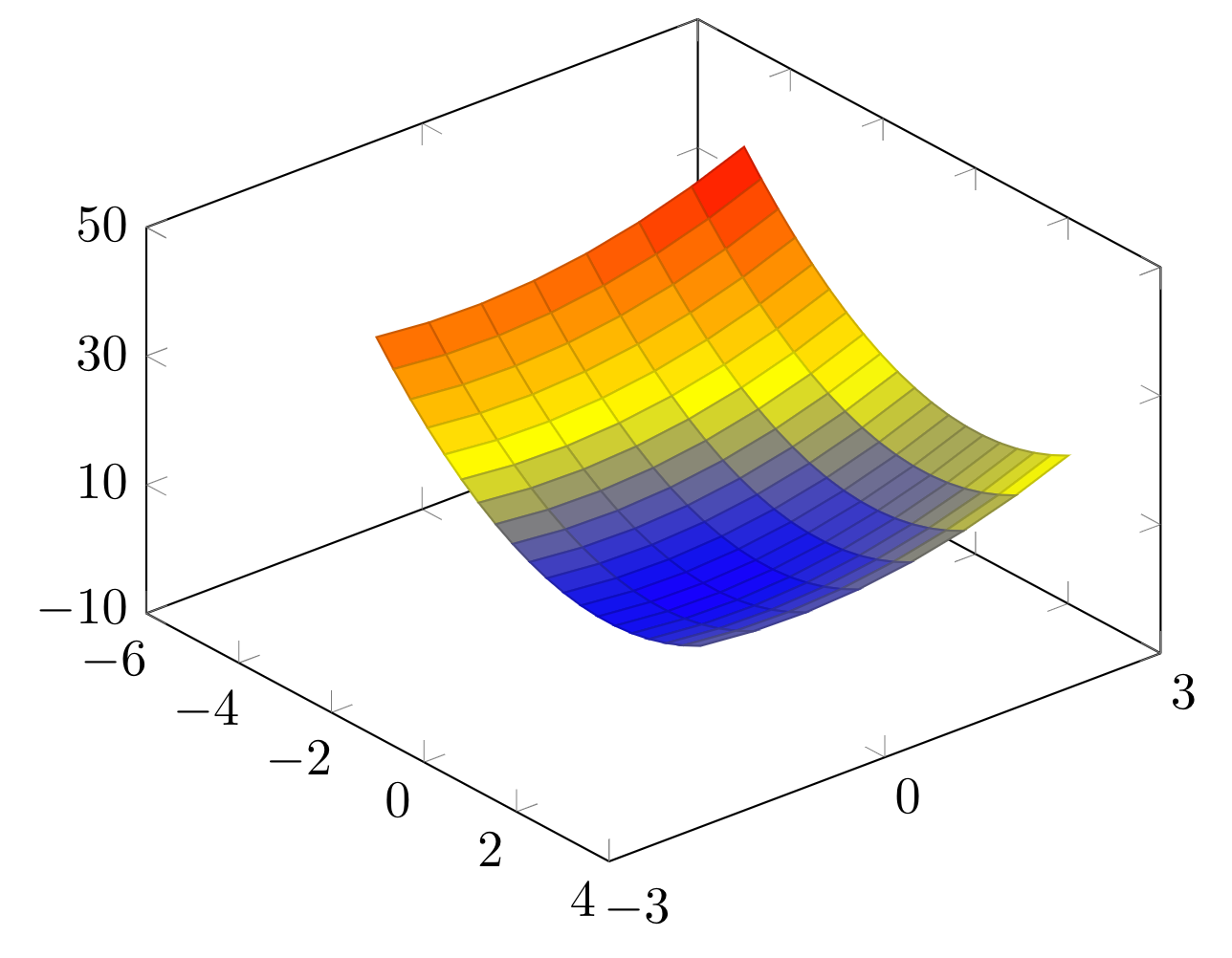
- Add filigree and way information technology
To prove the tick points meliorate on the plot, we can describe grid lines on the axis using grid option. If we don't need to draw whatever grids on a dimension, we can also prepare information technology off for just that dimension.
Let's say we don't need any grid lines for y dimension; all we demand to practice is to add ymajorgrids = simulated choice to our axis environment. For ten and z dimensions, we should use xmajorgrids and zmajorgrids options, respectively. In the next slice of lawmaking, we added grids to our plot, merely removed the ones for y dimension.
\documentclass [border = .2cm] {standalone} % Required packages \usepackage{pgfplots} \pgfplotsset{compat = newest} \begin{document} \begin{tikzpicture} \begin{axis}[view = {50}{40}, xmax = 4, xmin = -half-dozen, ymax = iii, ymin = -3, zmax = 50, zmin = -10, xtick = {-6,-iv,-two,0,2,4}, ytick = {-three,0,3}, ztick = {-10,10,30,50}, grid, ymajorgrids = false] \addplot3 [ domain=-5:two, domain y = -3:1, samples = xx, samples y = 8, surf] {ten^two + y^2}; \stop{axis} \end{tikzpicture} \end{document} 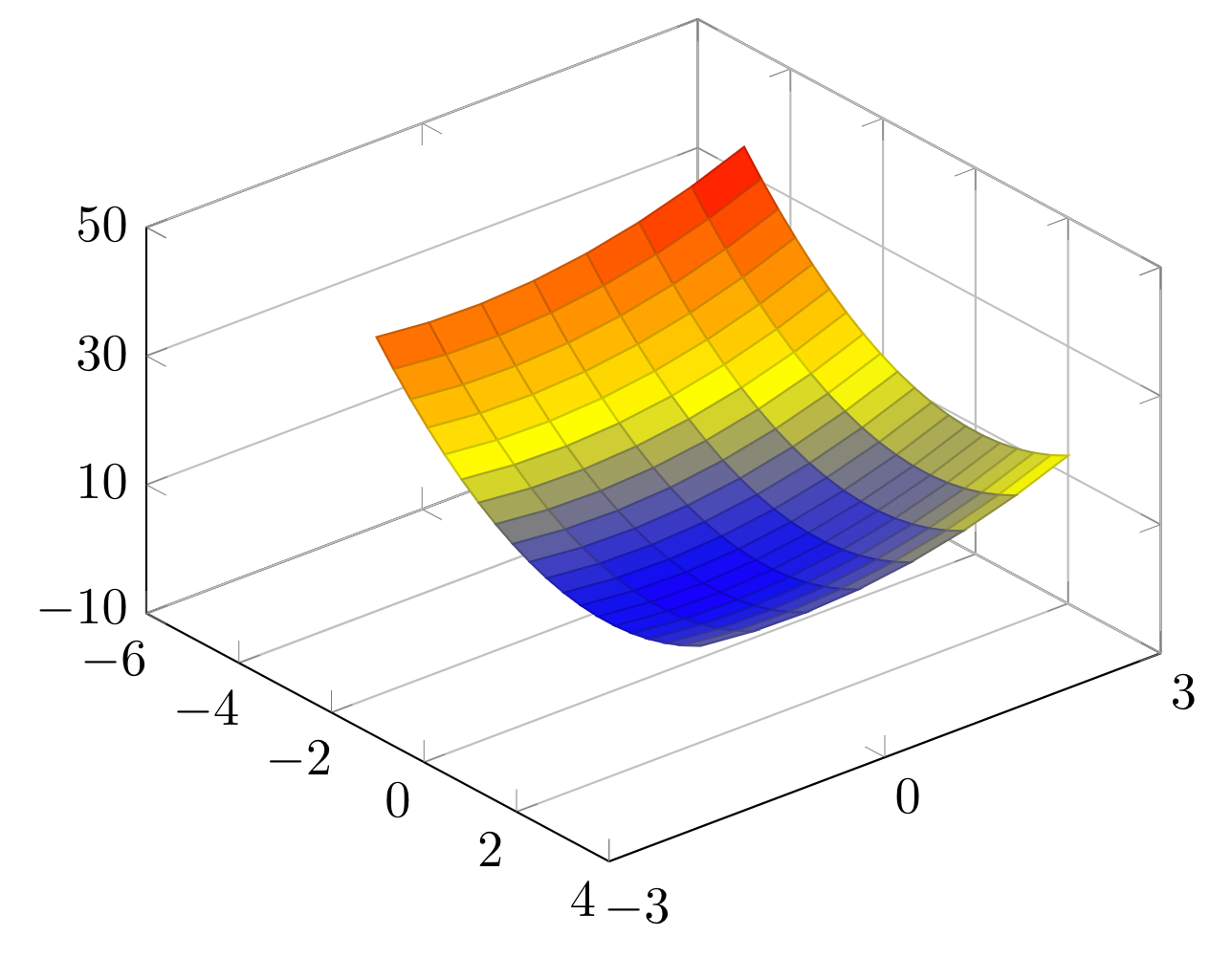
- Unit vector ratio
In our plot, z dimension has an interval of lx, and x dimension has an interval of 10, but the length of the z dimension is not six times the length of the x dimension. The reason for this is our cartoon environs trying to create an like shooting fish in a barrel to understand plot. However, we can modify the ratios between dimensions using unit of measurement vector ratio command. Information technology takes three parameters that is representing the aspect ratio for each dimension.
If we demand the same ratio for all of the dimensions, we can use the same parameter three times. If we demand twice the size for y dimension, we tin can set it to ane 2 one. Beneath, we gear up the ratios to 10 10 1.
\documentclass [border = .2cm] {standalone} % Required packages \usepackage{pgfplots} \pgfplotsset{compat = newest} \begin{document} \begin{tikzpicture} \brainstorm{centrality}[view = {50}{40}, xmax = 4, xmin = -vi, ymax = 3, ymin = -iii, zmax = fifty, zmin = -10, xtick = {-half-dozen,-4,-2,0,2,iv}, ytick = {-3,0,3}, ztick = {-ten,10,30,50}, grid, ymajorgrids = fake, unit vector ratio = 10 ten ane] \addplot3 [ domain=-5:2, domain y = -3:1, samples = 20, samples y = 8, surf] {10^2 + y^two}; \end{centrality} \stop{tikzpicture} \end{document} 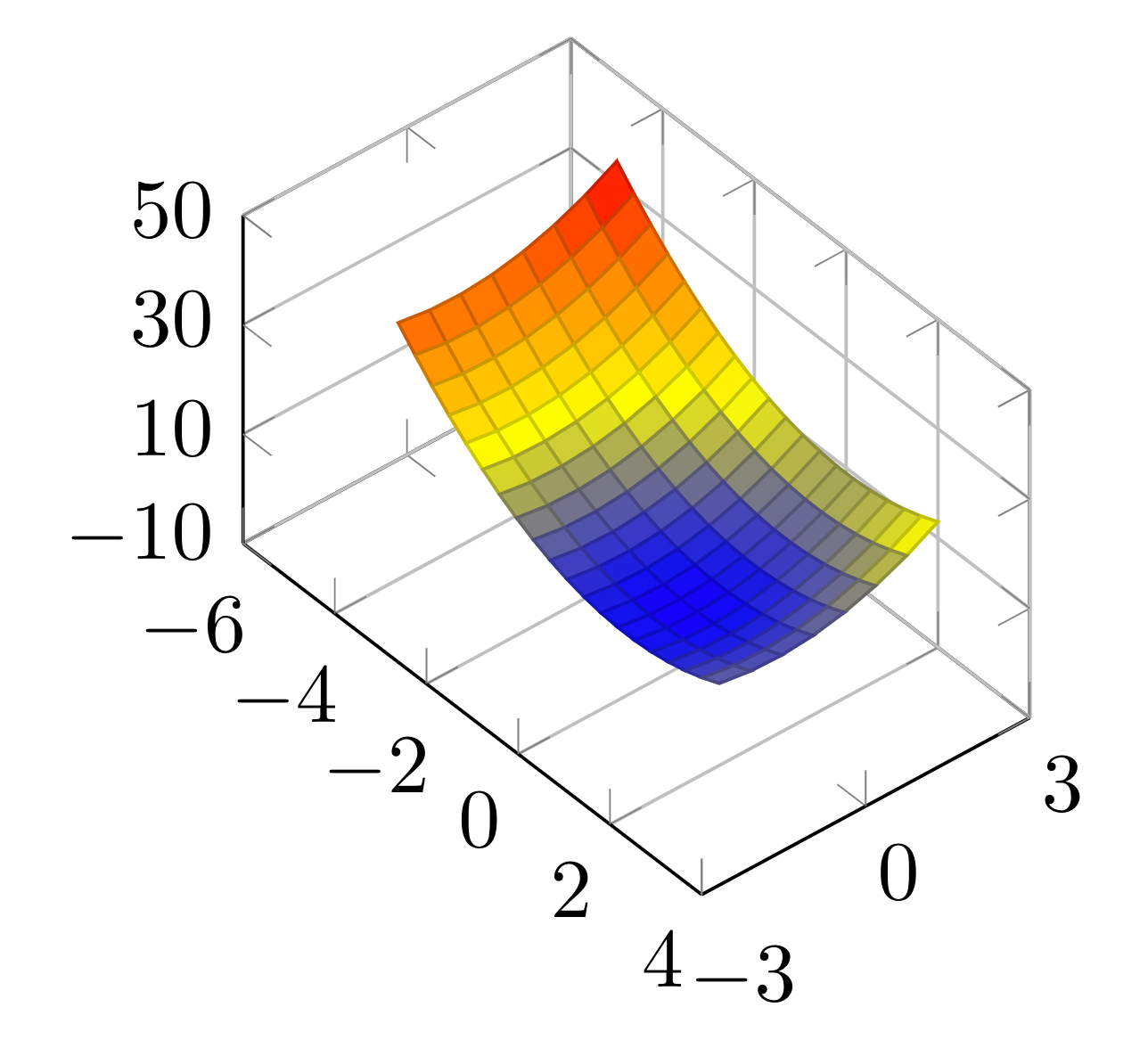
- 3D box
As a final option, we will add 3d box command to our plot. This command helps draw all the borders of the cuboid shape of our axes. To brand this happen, we demand to use the command with complete parameter. We can also apply it with consummate* parameter to depict the grid lines on all sides of our cuboid axes. Below, we removed unit vector ratio and ymajorgrids = false commands and added the 3d box control with complete* choice.
\documentclass [border = .2cm] {standalone} % Required packages \usepackage{pgfplots} \pgfplotsset{compat = newest} \begin{document} \begin{tikzpicture} \begin{centrality}[view = {50}{xl}, xmax = four, xmin = -6, ymax = iii, ymin = -iii, zmax = 50, zmin = -10, xtick = {-half dozen,-4,-2,0,two,four}, ytick = {-3,0,iii}, ztick = {-10,10,30,l}, grid, 3d box = consummate*] \addplot3 [ domain=-5:2, domain y = -3:1, samples = 20, samples y = 8, surf] {x^2 + y^ii}; \finish{centrality} \end{tikzpicture} \stop{document} Compiling this code yields:
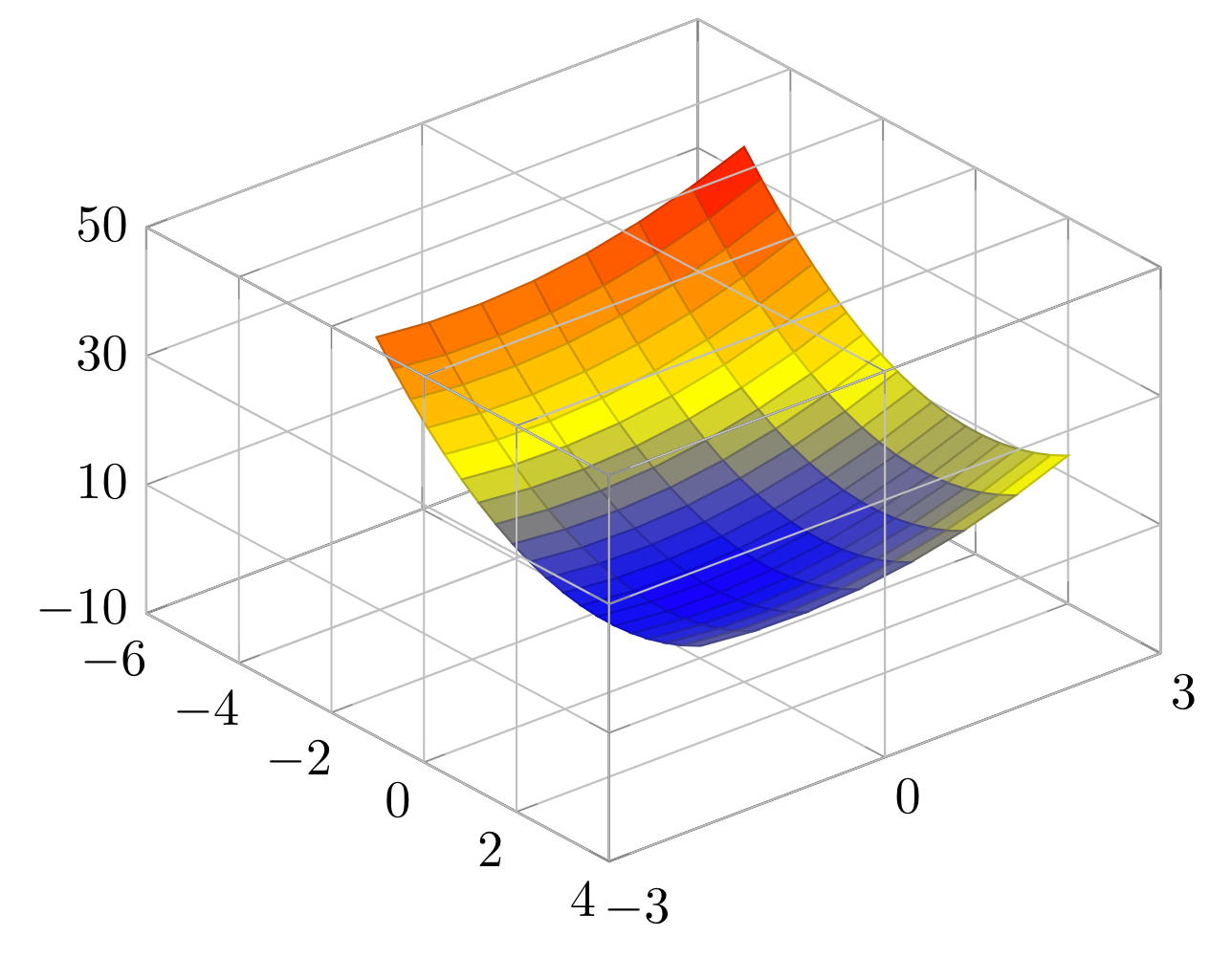
This concludes our 3 dimensional plotting in PGFPlots tutorial. For more than details, yous can check the PGFplots transmission.
Source: https://latexdraw.com/three-dimensional-plotting-in-latex/
0 Response to "draw 3d axis on d plot"
Post a Comment